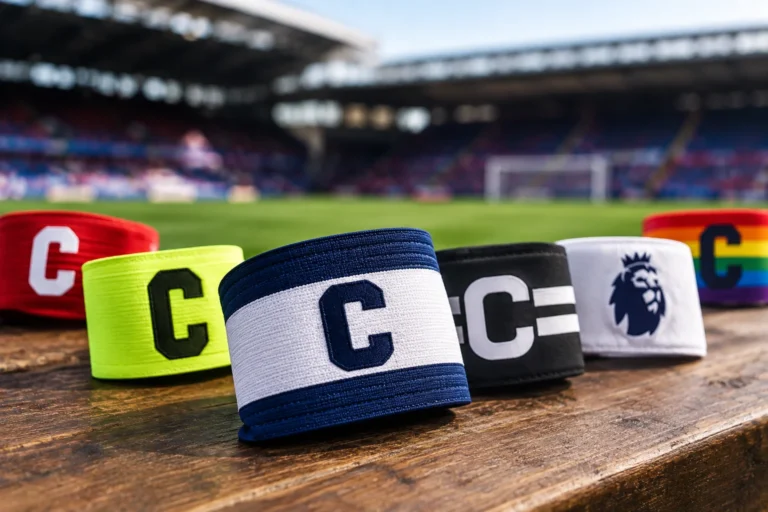




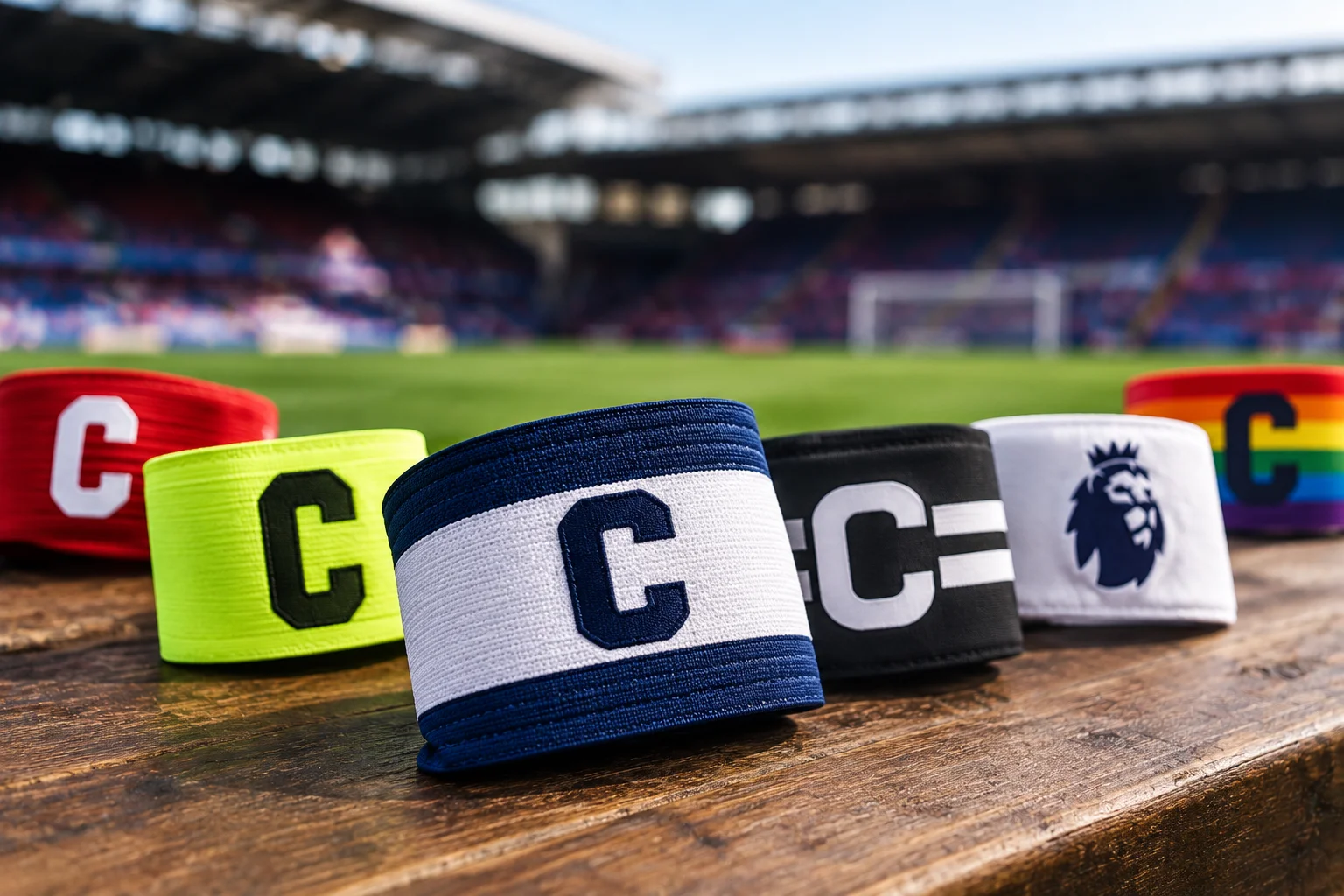
A captain’s armband is a strip of elasticated fabric worn above the elbow. It carries no official power beyond identifying which player the referee should speak to. And yet it has become one of the most loaded objects in football, given and taken away with enormous ceremony, argued over by supporters and occasionally by governments.
Its history is shorter than most people assume, and its meaning has changed considerably.
When did captains start wearing armbands?
Later than the role of captain itself, which is as old as the game.
Early football captains were identified by their position on the team sheet and by the fact that everyone knew who they were. There was no need for a visual marker in a game watched mostly by people who followed the same team every week. Armbands began appearing in the mid-twentieth century, initially as a practical aid for referees, and became standard through the 1970s and 1980s as football became a televised sport watched by people who needed help identifying who was who.
The rules now require a captain to be identifiable, and the armband is the accepted way of doing it.
What does the captain actually do?
Less than the ceremony suggests, formally, and more than it suggests, informally.
Officially, the captain is the player the referee addresses on matters concerning the team, the one who takes part in the coin toss, and the one who represents the team at ceremonial moments. That is the extent of the role in the laws of the game.
Informally, the captain is expected to lead: to organise on the pitch, to speak for the players in the dressing room, to set standards in training and to represent the club publicly. How much of that a given captain does depends on the player, the manager and the club’s traditions. Some captains are talismanic leaders. Others are simply the most senior player.
How did the armband become symbolic?
Through who wore it and how it was handed over.
Once armbands were universal, giving one to a player became a statement about that player’s standing. Managers used it to reward loyalty, to signal a change of era, or to bind a new signing to the club. Taking it away became a public demotion. Supporters attached meaning to all of this, and the armband became a proxy for questions about leadership, loyalty and who the club really belonged to.
The moment a departing captain hands the armband to his successor, on the pitch or in a photograph, has become a recognised ritual, and it did not exist a few decades ago.
Why has the armband become political?
Because it is the one part of the kit a player chooses, or appears to.
An armband can carry a colour, a message or a symbol, and because it is small and personal it has become the place where players and federations express support for causes. That has made it contested. Competitions have rules about what may appear on an armband, players and associations have tested those rules, and the disputes have sometimes reached governments and governing bodies.
The armband’s power as a symbol comes from its simplicity. It is a strip of fabric, but everyone looks at it.
Why does taking the armband away cause such a stir?
Because it is a public act with no private version.
A manager who loses faith in a player can drop him quietly, reduce his minutes, or leave him out of the squad without comment. Removing the captaincy cannot be done quietly. The armband is either on the player’s arm or it is not, and every supporter, journalist and teammate sees which. That visibility turns a management decision into a public judgement, which is why managers agonise over it and why the player concerned so often leaves the club soon afterwards.
The same visibility works in reverse. Handing the armband to a young player, or to a new signing, is a public declaration of confidence that carries more weight than any statement.
How has the design changed?
From plain to branded, in step with everything else on the kit.
Early armbands were a strip of fabric in a contrasting colour, often supplied by the club or the referee. Modern armbands are manufactured products, sometimes carrying a competition logo, a sponsor, a club crest or the word captain itself. Some are colour-coded to particular campaigns. Some clubs issue a new design each season alongside the kit.
For anyone interested in kit history, the armband has become a small but real marker of era, and our guide to dating a Leeds United shirt season by season shows how such small details fit together.
Who decides who wears it?
The manager, almost always, and it is one of the decisions supporters watch most closely.
Some managers choose the most experienced player. Some choose the one they believe best represents the club. Some choose a player they want to bind more tightly to the team, or one whose leadership they want to develop. A few clubs have traditions about the captaincy that managers are expected to respect.
The choice is examined because it reveals what the manager values. A captain who is not a regular starter, or one who is a new signing, tells supporters something about the manager’s priorities before a ball has been kicked.
Are there captains who never wore the armband?
Plenty, historically, and it is worth remembering when reading about earlier eras.
Before armbands were standard, a team’s captain was identified by reputation and by the team sheet. Many of the most celebrated captains in the game’s history led sides without wearing anything to mark them out, and photographs from those periods show no armband at all. That is not an oversight in the record. The armband simply did not exist as a fixture yet, and the captaincy was carried by the player rather than the kit.
What about vice-captains and stand-ins?
Every team needs one, and the handover during a match has its own small ritual.
When the captain is substituted or sent off, the armband passes to another player, usually a designated vice-captain. Supporters notice who receives it, and a manager’s choice of vice-captain is read as a signal about the succession. Some players have been given the armband as a stand-in so often that they became captain in all but name.
For a strip of elastic, the armband carries an extraordinary amount. It identifies, it honours, it demotes, it declares, and occasionally it provokes. No other part of the kit does as much with as little.
Frequently asked questions
When did football captains start wearing armbands?
They appeared in the mid-twentieth century as a practical aid for referees and became standard through the 1970s and 1980s as televised football grew.
What does a football captain actually do?
Officially, represent the team to the referee and at ceremonies. Informally, lead on the pitch, speak for the players and set standards, though how much varies by club and player.
Why is the captain’s armband controversial?
Because it is the one part of the kit that can carry a personal or political message, and competitions have rules about what it may show.
About the Author