


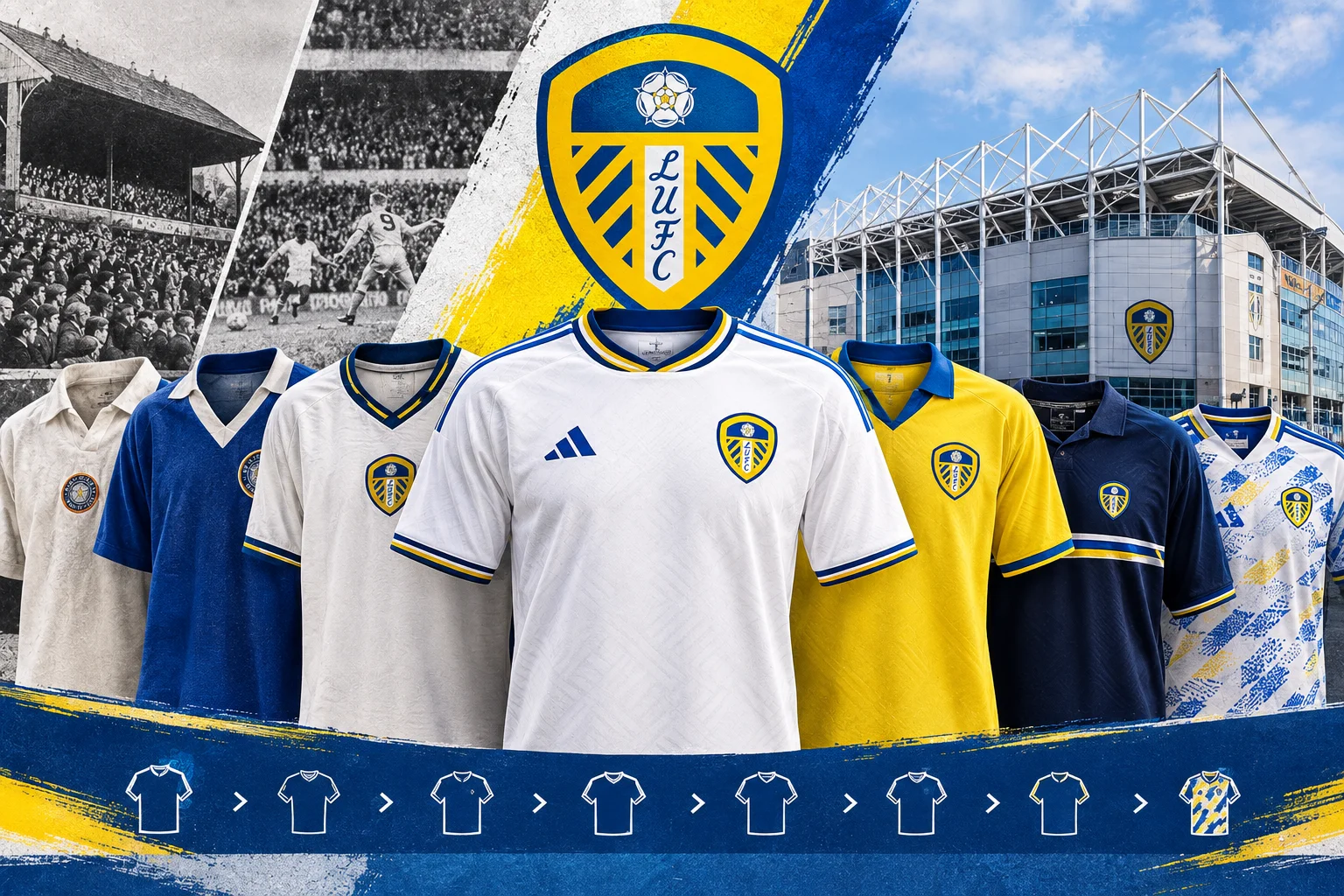
A club that plays in plain white has removed its most obvious dating tool. There is no pattern to change, no second colour to rebalance, no stripe width to shift. Everything that identifies a season has to happen in the details.
That makes Leeds shirts genuinely difficult to place, and it makes the process of placing them more interesting than at most clubs. The information is all there. It is just distributed across smaller elements.
Why is a white shirt hard to date?
Because the thing that would normally tell you is absent.
At a striped club, stripe proportion narrows a shirt to a decade. At a club with a two colour scheme, the balance between the colours does the same. At an all white club neither exists, and the white itself does not change in any way visible to the eye.
So the work falls to four elements: the badge, the sponsor, the collar and the trim. Each is less decisive on its own than a pattern change would be, but used together they narrow most shirts to a small range. Anyone working through leeds united shirts from different periods learns to read them in that order.
What does the badge tell you?
The most, and it should be the first thing you look at.
The club’s crest has gone through a series of genuinely distinct versions over the decades, changing shape, content and style substantially rather than being subtly redrawn. Some versions are circular, some shield shaped, some abstract. The rose has appeared and receded. The owl has come and gone.
Because these changes are infrequent and visually unambiguous, the badge places a shirt in an era faster than anything else available. It will rarely give you a single season, but it will usually give you a decade.
How much does the sponsor narrow it?
Substantially, and it is the natural second step.
Sponsorship deals run in blocks of several years, which means the name on the front pins a shirt to a defined window immediately. Where a club has had a long association with one sponsor, that window is wide and you will need the other elements. Where a deal was short lived, the sponsor alone can narrow things to two or three seasons.
Combining badge and sponsor usually gets you close. The badge gives the era, the sponsor gives the block within it, and the overlap is often only a few years wide.
What separates seasons within a sponsorship block?
The collar, almost always.
Collars change more frequently than any other element, and on a white shirt they are the most visible thing on the garment. Round necks, V-necks, pointed collars, button plackets and contrasting trim treatments all appear across the club’s history, often changing from one season to the next within the same sponsorship period.
Where the collar is plain and unchanged across several seasons, the sleeve cuffs sometimes differ, and the side panel treatment sometimes does too. Those are the last resort markers and they require a good reference photograph to use confidently.
Do the yellow and blue accents help?
They do, and they are underused as a dating tool.
Leeds have used yellow and blue as accent colours across much of their modern history, in collars, cuffs and trim detailing. The amount of accent colour and where it sits has varied considerably. Some eras use it as a thin line at the collar only. Others bring it across the shoulders or down the sleeves.
Because these accents are small areas of strong colour against white, they are visually prominent out of proportion to their size, which makes them easier to compare across shirts than the subtle differences in cut.
What about numbering and lettering?
A specialist marker, but a precise one when it applies.
Squad numbering conventions, font choices and the position of names on the back have all changed over time, partly through competition regulations and partly through manufacturer house styles. A shirt with a distinctive number font can often be placed to a specific period on that alone.
This is most useful on shirts that are otherwise featureless. A plain white shirt with an unremarkable collar and a long running sponsor may give you almost nothing until you turn it around.
What about the fabric itself?
A broad era marker rather than a precise one, but worth knowing when a shirt has lost its labels.
Heavy cotton belongs to one period and is unmistakable in the hand. The transition to polyester through the 1970s and 1980s produced fabrics that feel quite different from both cotton and from modern performance knits. Current shirts use light engineered knits with visible texture variation and often mesh panels.
Those three categories are easy to distinguish by touch, which narrows a shirt to a broad era before you have looked at anything else. Within the polyester period, the weight and the tightness of the knit continued to change, though separating those requires examples side by side.
Which seasons are the most distinctive?
The ones where several elements changed at once, which happens less often than you would expect.
A new badge arriving alongside a new sponsor and a new collar treatment produces a shirt that places itself immediately. Those seasons are the easy ones. The difficult ones are the long stable periods where the same badge, the same sponsor and a similar collar ran for four or five years, and where only fine detail separates one from the next.
Collectors tend to value the distinctive seasons more, which is partly aesthetic and partly practical: a shirt that can be identified confidently is an easier shirt to buy and sell.
Reading a white shirt properly
Badge for the era, sponsor for the block, collar for the season, accents and numbering for confirmation. In that order, and with a reference photograph where you can get one.
It is more work than reading a striped shirt, which is the price of an identity that never changes.
One practical note for anyone doing this seriously. Keep a reference photograph of any shirt you identify confidently, with the season recorded. Building a small personal archive is far more useful than relying on memory, because the differences between adjacent seasons on a white shirt are exactly the kind of detail that blurs after a few months.
The online market is where most of this identification now happens, and our piece on how the retro kit market moved online covers what that changed. For the origin of the all white kit itself, the Leeds United all-white story has the background.
Frequently asked questions
How do I identify which season a Leeds shirt is from?
Work in order: badge first for the era, then sponsor for the block of years within it, then collar treatment to separate seasons, then accent colours and numbering to confirm.
Why are white football shirts harder to date?
Because there is no pattern or second colour to change between seasons. All the identifying information sits in smaller elements — badge, sponsor, collar and trim — rather than in the kit’s overall appearance.
Can you date a shirt by the fabric?
To a broad era, yes. Heavy cotton, early polyester and modern engineered knits feel quite different in the hand, which narrows a shirt to a period before you examine anything else.
Do number fonts help date a shirt?
Yes, and they are precise when they apply. Numbering conventions and fonts have changed through competition regulations and manufacturer house styles, which can place an otherwise featureless shirt to a specific period.
About the Author