
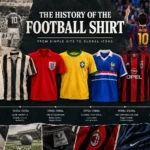

Leeds United play in all white because a manager decided, in 1961, that his struggling Second Division side should look like the best team in the world. Don Revie had watched Real Madrid win five European Cups in white and reasoned that if his players dressed like champions they might start to believe it. It is one of the few kit decisions in football that demonstrably worked. This is the story of the Leeds United kit, from blue and gold to Revie’s white, through the smiley badge and the 1992 title to the adidas shirts of 2026/27 with a Red Bull logo on the front.
Blue and gold, then blue and white
Leeds United were formed in 1919 from the ruins of Leeds City, which had been expelled from the Football League for illegal payments. The new club wore blue and gold, the colours of the city’s coat of arms, and later blue and white, with occasional yellow trim. None of it produced success. Leeds were a modest club with a modest kit until the early 1960s, when the club appointed a player-manager who had never managed before.
1961: Revie’s white
Revie’s switch to all white was made in his first months and was greeted with some bafflement. Within four years Leeds were runners-up in the First Division and FA Cup finalists, and within a decade they were champions, in 1969, and had won the Fairs Cup twice, the FA Cup in 1972 and a second league title in 1974. Billy Bremner, Jack Charlton, Johnny Giles, Peter Lorimer, Eddie Gray and Norman Hunter wore the plain white shirt with a blue and gold owl crest, later replaced by a simple “LU” monogram, and the kit became synonymous with a team that was admired and disliked in equal measure.
1973: Admiral and the smiley
In 1973 Leeds signed with Admiral, the first English club to have a branded, commercially sold kit, and the shirt carried a new crest: a yellow and blue “smiley” badge that looked like a face. Admiral also introduced the numbered sock tags that players threw to the crowd, and the replica shirts that supporters could buy for the first time. The smiley badge was worn for the 1975 European Cup final in Paris, lost to Bayern Munich after two disallowed goals, and it has been reissued so often since that many supporters assume it is older than it is.
1992: the last champions of the old league
Howard Wilkinson’s Leeds won the First Division in 1992, the final season before the Premier League, in an Umbro shirt with a small blue crest and a blue and yellow trim. Gordon Strachan captained the side, Gary McAllister ran the midfield, Lee Chapman scored the goals and Eric Cantona spent five months at Elland Road before crossing the Pennines. The 1992 shirt is the club’s most-reissued design of the modern era, and the last one worn as champions of England.
Rise, collapse and the wilderness
The Nike kits of the late 1990s and early 2000s, with the Strongbow logo, were worn by David O’Leary’s young side to the 2001 Champions League semi-final. The financial collapse that followed took the club out of the Premier League in 2004 and into League One by 2007, and the shirts of the next decade were worn through administration, points deductions and a rotating cast of owners. Kappa made the kits from 2015, and Marcelo Bielsa’s promotion in 2020, after sixteen years away, was won in one.
adidas, 49ers and Red Bull
adidas took over in 2020 and has produced a run of clean white designs, with the three stripes on the shoulders and the 1970s-style crest. Ownership passed to 49ers Enterprises in 2023, and in 2024 Red Bull bought a minority stake and became the front-of-shirt sponsor, a deal that was controversial with supporters who feared the club would become a franchise. It has not, and the shirt has kept its white, but the size of the logo remains the one thing reviewers complain about. Daniel Farke’s side won the Championship in 2025 with 100 points, and survived their first season back.
2026/27: the best Leeds kits in years
The kits for the second Premier League season have been among the best received in the division: a clean white home shirt with blue and yellow trim, and an away design that reviewers have placed near the top of the league. Leeds raised the price of the adult replica by £5 to £75 for the season, in line with Bournemouth and Hull, at a time when ten clubs are charging £80 or more, which still leaves it £10 cheaper than the established top clubs. The season began with two wins over Nottingham Forest, in the league and the League Cup.
The away kits
Leeds’ change kits have almost always been yellow, from the Admiral designs of the 1970s through the yellow-and-blue Umbro of 1992 to the current adidas away shirt, and the colour has become as much a part of the identity as the white. The exceptions, including a salmon third kit in the Bielsa years, proved the rule. The 2026/27 away shirt, yellow with blue trim, has been rated among the best change kits in the division.
Elland Road and the shirt
The white has been worn at Elland Road since 1919, and the ground itself is part of the kit’s image: the Bremner statue at the corner of the East and South stands, the Kop behind one goal, the John Charles Stand along the touchline. The 49ers ownership has confirmed plans to expand the ground towards 53,000, and the club’s return to the Premier League has filled it every week. For supporters who remember the white shirt being worn in front of 20,000 in League One, that is the change that matters most.
The price of white
At £75 the Leeds replica is £10 below the top clubs and £15 below Tottenham, and the club has framed the £5 increase as the first in several seasons. The Red Bull logo is included; for supporters who would rather it were not, the retro range, with the smiley badge and no sponsor, remains the club’s best-selling line.
Why white works for Leeds
Revie’s insight was that white is the colour of clubs that expect to win, and sixty years on it still reads that way. Leeds are one of only a handful of English clubs to wear all white, the others being much smaller, and the shirt is instantly placed in any highlights package. It also takes a sponsor badly, which is the Red Bull problem: on a busy kit a large logo disappears, on a white one it is the first thing you see.
Sixty-five years after the change, the white shirt is worn by a club that has been champions, bankrupt and back again, and it has looked the same throughout. That is exactly what Revie intended. For the latest Premier League team news and kit stories, visit our homepage.
About the Author

3 thoughts on “Leeds United Kits: The All-White Story”