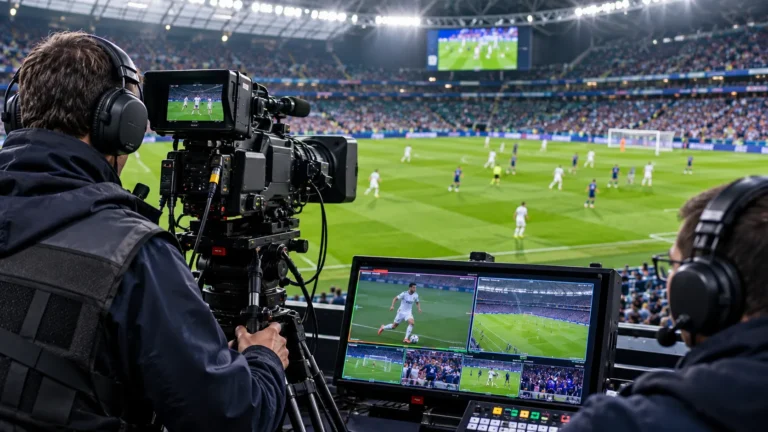


A televised match involves more people than are on the pitch, and understanding how a football match is broadcast explains several things that puzzle viewers why the replay angle is always available, why the commentary sometimes does not match the picture, and why the goal you heard the neighbours celebrate arrives a few seconds later on your screen.
The whole operation is built around one principle: capture everything, and decide what to show in real time.
The camera plan
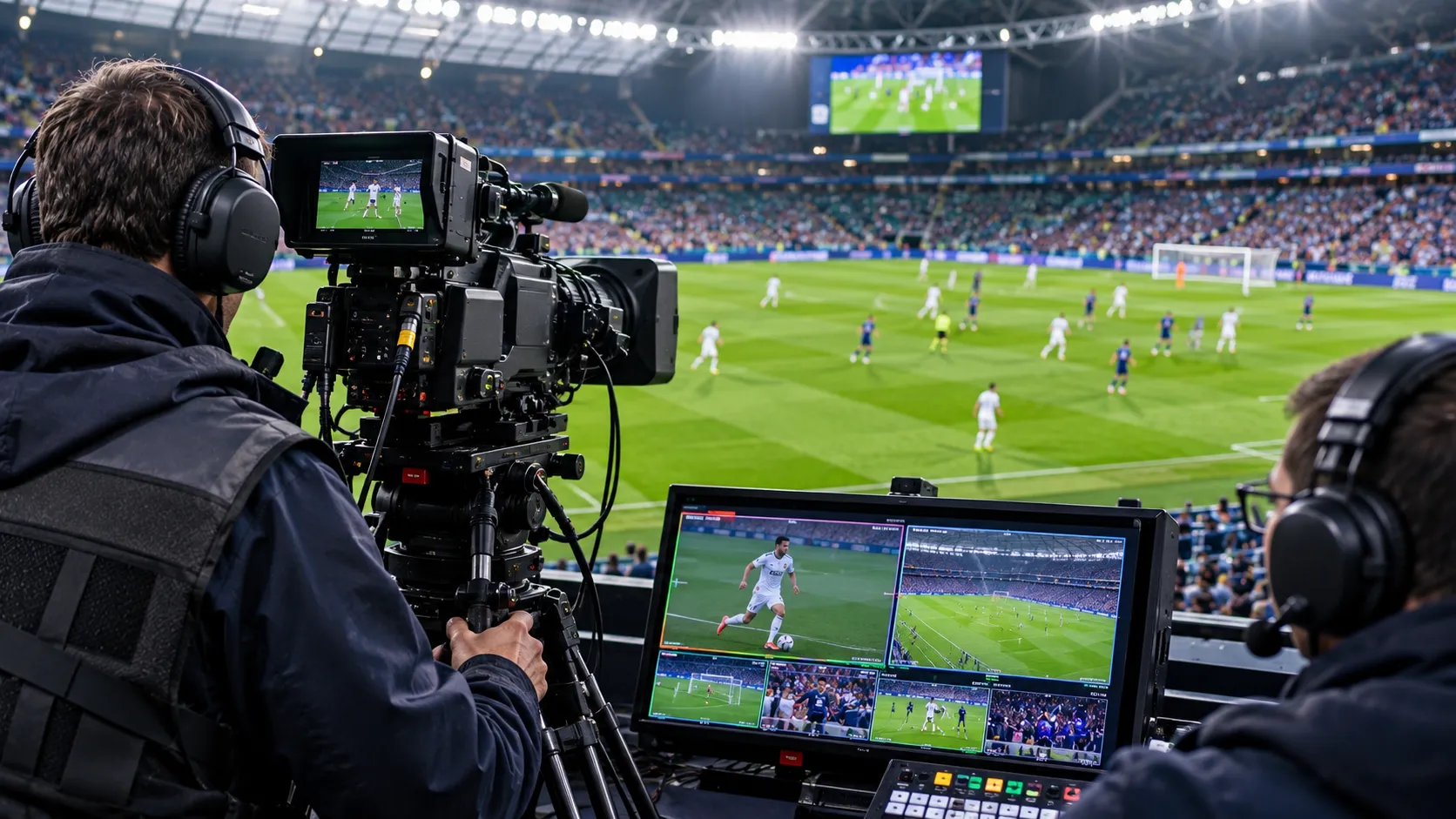
A major fixture is covered by a large number of cameras, well into the twenties and sometimes beyond. They are positioned to a standard plan so that any incident is captured from several angles simultaneously.
The main camera sits high at the halfway line and provides the shot you watch for most of the match. Supporting it are cameras level with each penalty area, behind each goal, at reverse angles on the opposite side, and pitchside handheld units for close work.
Then the specialist positions: elevated cameras on cables above the pitch, high-frame-rate cameras for slow-motion replays, dedicated cameras on each manager’s technical area, and tightly framed units covering the goal lines.
Who actually produces it
Usually a host broadcaster, which produces a single clean coverage of the match pictures, crowd and pitch sound, and basic graphics known as the world feed.
Individual rights holders then take that feed and add their own layer: commentary in their own language, studio presentation, pundits, their own graphics and their own replays. That is why the same match looks broadly identical in every country and sounds completely different.
The arrangement exists because producing full coverage is expensive and duplicating it for every market would be absurd. It also means the director choosing which camera you see is working for the host broadcaster rather than for your channel.
Why is the picture delayed?
Because every stage of the chain adds time. Encoding the signal, transmitting it, distributing it through a network and decoding it at your device all take fractions of a second that accumulate.
Terrestrial and satellite transmission is typically a few seconds behind the pitch. Internet streaming is usually worse, sometimes considerably, because streaming protocols buffer in order to deliver a smooth picture over an unreliable connection.
The practical consequence is familiar to anyone who has watched a match while following social media, or in a flat with a neighbour on a different service. The pitch is the only place the match happens in real time, and everything else is a delayed reconstruction of it.
The data layer
Modern coverage sits on top of a tracking system that records the position of every player and the ball many times a second, generating the distance, speed and possession figures that appear on screen.
Those systems feed more than graphics. They supply the clubs’ own analysis, the league’s official statistics, and in several competitions the technology used to assist officiating decisions.
The graphics you see are a small and curated fraction of what is being captured. A broadcast picks the numbers that tell a story; the full dataset goes to the clubs, who use it for the purposes described in training and recruitment.
How is the sound put together?
More constructed than viewers realise. Pitch microphones are positioned around the perimeter to capture ball strikes and player voices, crowd microphones capture atmosphere from the stands, and the mix between them is an active decision throughout the match.
Crowd sound is balanced rather than simply recorded. A director will raise the stand microphones during a goal and reduce them when commentary matters, and the result is a version of the atmosphere rather than a reproduction of it.
Commentary is sometimes produced at the ground and sometimes from a studio elsewhere, watching the same feed you are. The second approach is cheaper and is why commentary occasionally describes something the picture has not shown the commentator is seeing the same director’s cut, with no extra information.
What happens in the truck
The production gallery is a vehicle parked outside the ground, and the people in it are making a continuous stream of decisions at a speed that does not allow for discussion.
A director calls which camera is live, a vision mixer executes it, a replay operator is simultaneously building the sequence of angles that will be shown within seconds of any incident, and a graphics operator is cueing the overlays. A producer is tracking the match as a narrative and deciding what the coverage should be about.
The replay operators do the work viewers notice most. Every significant incident has to be assembled from multiple angles, in the right order, while the match continues, and the decision about which angle best shows a contested moment is made in a few seconds under pressure.
None of this is visible and all of it is why coverage of a major fixture looks the way it does. A smaller production with eight cameras and two operators covers the same match and the difference on screen is immediate, which is why lower-division coverage looks the way it does and why the gap between a showpiece fixture and an ordinary one is so visible on screen.
The scheduling consequence
Broadcast requirements are the reason kick-off times move, and the reason they move so late. Rights contracts specify how many matches a broadcaster may select and how far in advance, and the selections drive the fixture calendar rather than the other way round.
In the United Kingdom there is also a protected period on Saturday afternoons during which matches are not televised domestically, a long-standing arrangement intended to protect attendances at grounds across the pyramid.
That protection shapes the whole weekend schedule. Matches are moved to earlier and later slots to create televised windows around the protected period, which is why a Saturday has fixtures at four different times and why travelling supporters plan around announcements rather than the published fixture list.
What it costs and why it matters
An outside broadcast for a major fixture involves a substantial crew, several vehicles, and equipment worth a great deal, for one match. The cost is justified by the rights fees, which are the largest income stream in top-level football.
That relationship is the single most important fact about the modern game’s finances. Broadcast money pays for most of what clubs spend, and in exchange broadcasters determine when matches are played and how they are presented.
Supporters are entitled to find that trade uncomfortable and it is not a hidden arrangement. The money that transformed the sport came with conditions attached, and the inconvenient kick-off time is one of them as is the slow disappearance of the traditions the money replaced, discussed in the matchday programme. The preparation on the other side of the camera is covered in what a football pre-season is actually for.
Frequently asked questions
How many cameras cover a match?
Well into the twenties for a major fixture, positioned to a standard plan so every incident is captured from several angles at once.
What is the world feed?
The host broadcaster’s clean coverage pictures, pitch and crowd sound, basic graphics which individual rights holders take and add their own commentary and presentation to.
Why is the broadcast delayed?
Encoding, transmission, distribution and decoding each add time. Terrestrial and satellite are a few seconds behind; internet streaming is usually worse because it buffers.
Why do kick-off times change so late?
Because rights contracts let broadcasters select matches within a set notice period, and those selections drive the schedule around the protected Saturday afternoon period.
About the Author