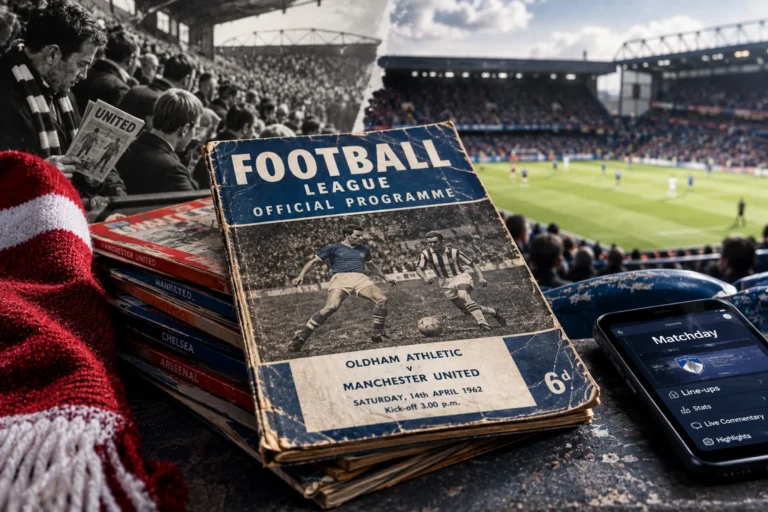




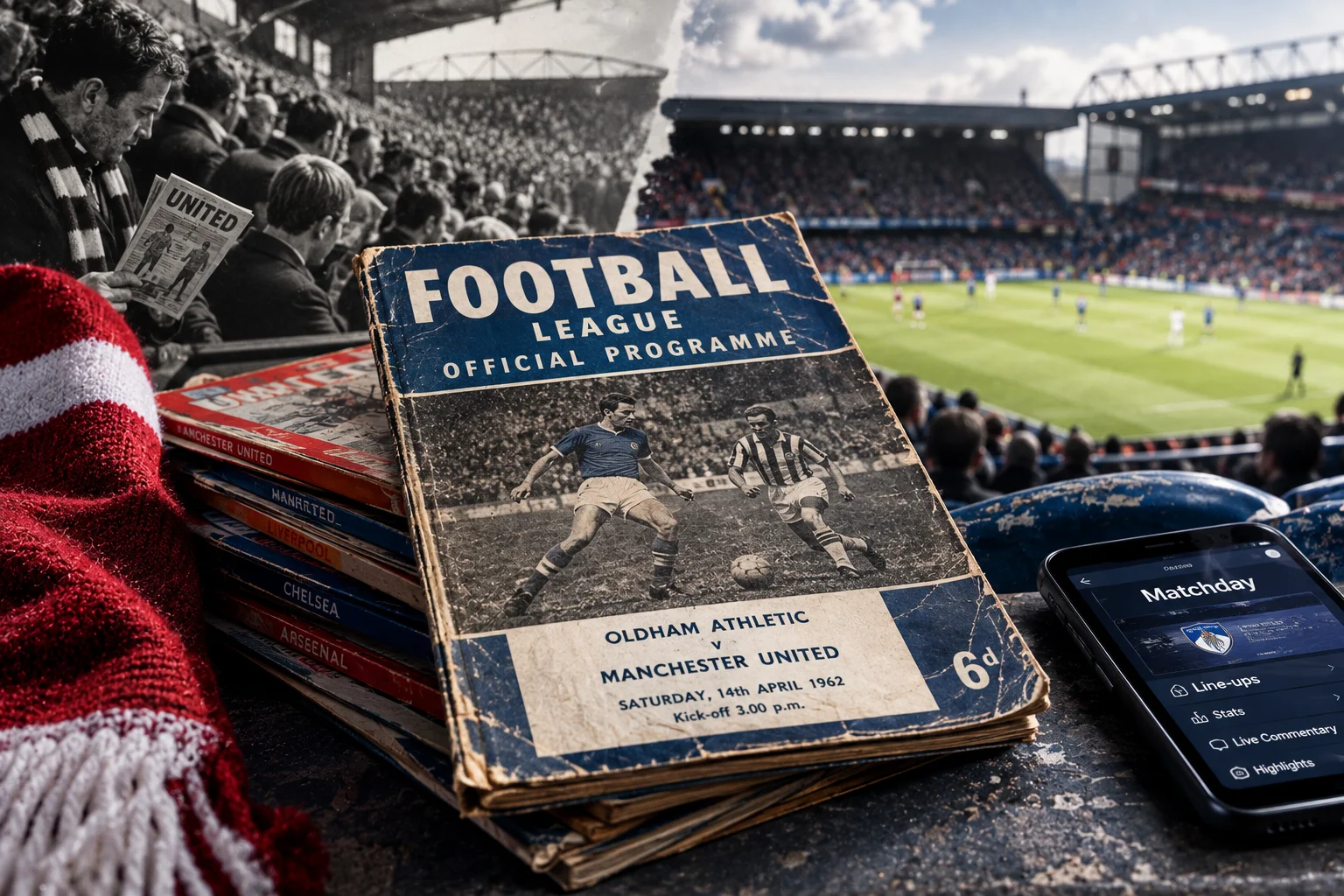
For most of football’s history, going to a match meant buying a programme. It told you the teams, carried the manager’s notes, and became a small record of the day. For generations it was as much a part of the ritual as the ground itself. Now it is fading, squeezed by the internet and changing habits, and its decline marks the end of one of football’s oldest traditions. Its history, and its slow disappearance, say something about how watching football has changed.
What was the matchday programme for?
Information, first, and then much more.
The original purpose was practical: to tell spectators who was playing, in an era before players’ names were on shirts and before anyone could look up a team online. The programme listed both teams, the officials, and basic information about the match. For a spectator far from the pitch, it was the only way to know who was who.
Around that practical core, the programme grew. It carried the manager’s notes, features on players, club news, statistics and advertising, becoming a small magazine produced for every home match.
How did it become a tradition?
Through repetition and ritual.
Buying the programme became part of the matchday routine, purchased on the way in and read before kick-off and at half-time. For many supporters it was an automatic part of going to the game, as fixed as the walk to the ground or the half-time cup of tea. Programmes were kept, collected, and stored, becoming a physical record of matches attended over years and decades.
The programme was also, for a long time, the club’s main way of communicating directly with its supporters, which gave it an importance beyond its content.
What did programmes contain?
A mixture that evolved with the game.
The manager’s notes were a fixture, a direct message to supporters that could set the tone for a match or respond to recent results. There were features on players, often the only way supporters learned anything personal about the men they watched. There were statistics, league tables, news of upcoming fixtures, and a great deal of advertising, which helped fund the production.
The quality varied enormously, from thin, cheaply printed sheets at smaller clubs to glossy publications at the top. But the basic contents were consistent across the game, and they reflected what supporters could not easily find elsewhere.
Why is it fading?
Because almost everything it offered is now available instantly and free.
The internet provides team news, player features, statistics and fixtures immediately and at no cost, which has removed most of the programme’s original purpose. Younger supporters, used to finding everything on a phone, have less reason to buy a printed publication, and sales have fallen steadily. Some clubs have reduced their programmes, moved them online, or stopped producing them altogether.
The programme is a victim of the same shift that has changed so much about following football: the move from physical and local to digital and instant. What was once essential has become, for many, unnecessary.
How much are old programmes worth?
It varies enormously, and follows the same logic as old shirts.
A programme from an ordinary league match, produced in large numbers and kept by many, is worth little however old it is. A programme from a famous match, a historic final or an occasion few expected to matter is worth far more, because fewer survive and more people want one. Condition matters greatly, since programmes were printed on cheap paper and handled on matchdays, so a clean, undamaged example of a sought-after programme is rare. The most valuable are those from matches whose significance was not clear at the time, which is why so few were kept.
Why do collectors still prize it?
Because a programme is a physical record of a specific day that cannot be recreated.
Each programme is tied to one match, one afternoon, and for collectors that specificity is the point. Programmes from famous matches, from historic occasions, or simply from long ago are collected and traded, and a complete run of a club’s programmes is a genuine archive of its history. The programme from a memorable match is a tangible connection to it in a way a webpage never is.
This is the same impulse that drives shirt collecting, covered in our piece on how the retro kit market found its home: the value of a physical object tied to a moment, which grows rather than fades as the moment recedes.
Could the programme survive in another form?
Some clubs are trying, with mixed results.
Digital programmes, available on a phone, preserve the content while losing the physical object, and they have not captured supporters in the way the printed version did, partly because a digital file is not something to keep or collect. A few clubs have moved towards collectable, higher-quality printed programmes aimed at those who still want them, treating the programme as a premium keepsake rather than a mass-market publication. Whether either approach sustains the tradition is unclear.
The most likely future is that the programme survives as a niche product for collectors and traditionalists rather than the universal matchday purchase it once was, which is a quieter end than disappearance but an end of sorts all the same.
The programme’s decline tracks a wider change: the move from football as a physical, local, tangible experience to one that is increasingly digital and remote. The programme was something you held, kept and returned to, and its replacement by a screen is of a piece with everything else that has made the modern matchday less tangible than the one older supporters grew up with.
What is being lost?
A small ritual, and a form of record.
The programme’s decline is not a tragedy, but it is a loss of something. It was a physical marker of attendance, a thing to keep, a small ceremony of buying and reading that was part of what made going to a match different from watching one. Its disappearance is one more way in which the matchday experience has become less tangible, and supporters who grew up with it feel the absence even as they understand why it happened.
Frequently asked questions
What was a football matchday programme?
A publication sold at matches, originally to tell spectators who was playing, which grew to include the manager’s notes, player features, statistics and club news.
Why are matchday programmes disappearing?
Because the internet provides team news, features and statistics instantly and free, removing the programme’s original purpose. Sales have fallen and some clubs have stopped producing them.
Why do people collect football programmes?
Because each is a physical record of a specific match, and programmes from famous or historic occasions are tangible connections to them, prized the way collectors prize old shirts.
About the Author