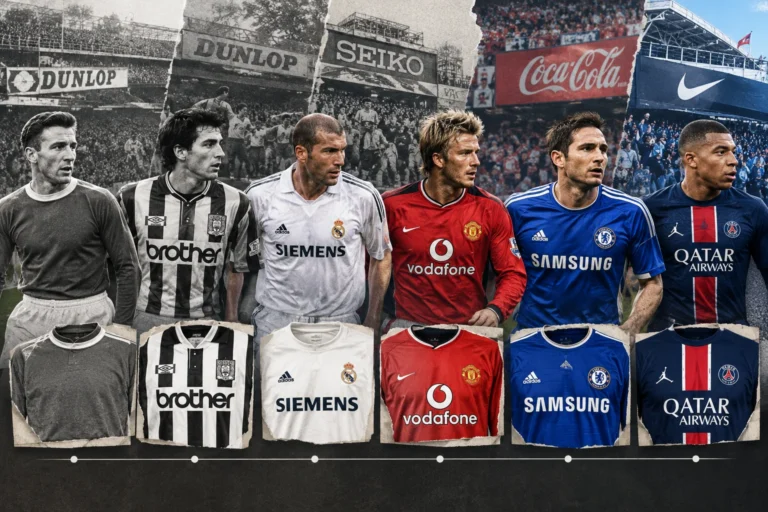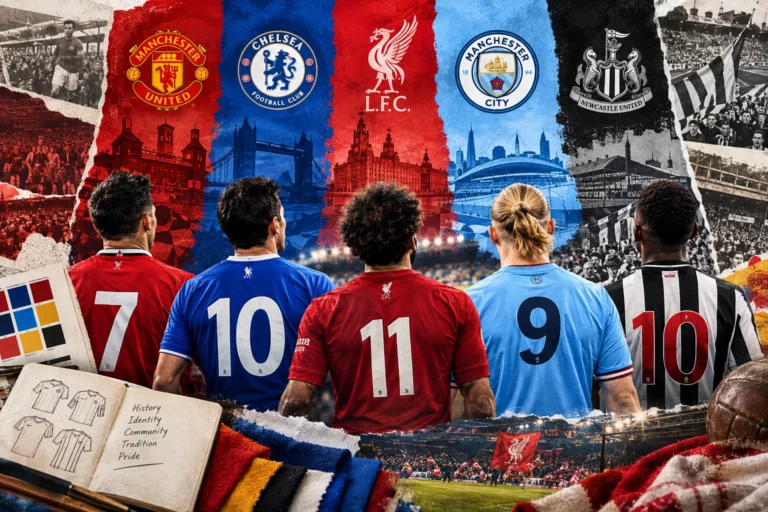




A club’s colours are the most permanent thing about it. Managers, players, stadiums and badges all change; the colours almost never do. They are the first thing a supporter learns and the thing that would cause the most anger to alter. Yet the origins of those colours are often surprisingly mundane, a matter of what was available, who was copied, or simple chance, and the meaning they carry was earned over time rather than built in from the start.
Where do club colours come from?
A mixture of borrowing, local meaning and accident.
Some clubs took their colours from a local institution: a school, a church, a workplace, a town’s coat of arms. Some copied a successful club of the era, hoping a little of its fortune might follow the colours. Some chose colours for a reason long since forgotten, or landed on them because that was what the first kit happened to be made of. The grand origin stories supporters sometimes believe are frequently later inventions.
What matters is not the origin but the permanence. Whatever the reason a club first wore its colours, once it had worn them long enough they became fixed.
Why do some clubs copy others?
Because in football’s early days, success was something to emulate.
When a particular club dominated early football, others sometimes adopted its colours in the hope of sharing its success, or simply out of admiration. Several clubs wear the colours they do because a founder admired a leading side of the day. Those adoptions that stuck became identities in their own right, and the original reason faded while the colours remained.
This is why the same colours recur across football without any connection between the clubs wearing them. The link is to a shared history of copying, not to each other.
Why do colours almost never change?
Because they are the one thing supporters will not accept being altered.
A club can change its badge, its stadium, its manager and its entire squad, and while supporters may complain, they accept it. Changing the colours is different. The colours are the club’s identity in the most fundamental sense, the thing a supporter feels they belong to, and an attempt to change them provokes a reaction unlike anything else. The handful of clubs that have changed colours, usually long ago or under unusual circumstances, are exceptions that prove the rule.
This permanence is why colours are such a reliable anchor. Everything else about a club is negotiable; the colours are not.
What makes a colour hard to reproduce?
Some colours are far more demanding than others, which affects how faithfully a shirt matches across the years.
White shows every flaw and yellows with age. Sky blue sits in a narrow band where a small shift reads as wrong. Certain reds and purples are made with less stable dyes that fade or bleed. A club whose colour is hard to reproduce will find its shirts vary more between manufacturers and eras, which is both a challenge for the makers and a useful detail for collectors trying to place a shirt. The colour that carries all the meaning is sometimes the one hardest to get right.
Do away colours carry meaning too?
Less than the home colours, but sometimes more than expected.
A few clubs have a second colour almost as established as their first, worn so often and in such memorable circumstances that it acquires its own meaning. An away colour tied to a famous match or a great season can become beloved in its own right, and some supporters are as attached to a traditional away colour as to the home one. But these are exceptions. For most clubs the away colours are changeable, and the meaning concentrates overwhelmingly in the home colours, which are the ones that never move.
What do the colours come to mean?
Everything the club’s history pours into them.
A colour that started as an arbitrary choice becomes, over decades, soaked in meaning: the triumphs, the defeats, the players and the matches all attach to it. A supporter seeing their club’s colours feels something that has nothing to do with the colour itself and everything to do with what has been associated with it. The colour becomes a vessel for the club’s whole history.
This is why the shade matters so much, and why supporters notice and object when a manufacturer gets it slightly wrong. The colour is not just a colour; it is the accumulated meaning of the club, and a wrong shade feels like a small betrayal of all of it.
What happens when a club does change colours?
It is remembered, and rarely forgiven quickly.
The handful of clubs that have changed their colours, whether long ago under different circumstances or more recently under new ownership, have found it among the most contentious things a club can do. Supporters treat it as an attack on the club’s identity, and the reaction can be fierce enough to force a reversal. Where a change has stuck, it has usually required decades for the new colours to acquire the meaning the old ones carried, and the memory of the change lingers in the club’s history.
This is why even commercially minded owners rarely touch the colours. Almost everything else about a club can be monetised or modernised; the colours are the one thing that resists it.
How do clashes complicate it?
They are the reason the away kit exists, and the one situation where colours must yield.
When two clubs with similar colours meet, one has to change, which is why clubs keep a second and often a third set of colours. The home colours are sacred; the away and third colours are where a club has freedom, and where it sometimes expresses a secondary identity or simply experiments. Our piece on the story of the away kit covers how that necessity became a design playground.
The clash rule is the one force that can override a club’s attachment to its colours, and even then only for ninety minutes.
Frequently asked questions
Where do football club colours come from?
A mixture of sources: local institutions like schools or churches, copying a successful club of the era, a town’s coat of arms, or simple chance. The grand origin stories are often later inventions.
Why don’t football clubs change their colours?
Because the colours are the club’s most fundamental identity, the thing supporters feel they belong to, and changing them provokes a reaction unlike any other alteration a club can make.
Why do different clubs share the same colours?
Often because early clubs copied the colours of successful sides of the day, in the hope of sharing their fortune. The colours stuck even as the original reason faded.
About the Author