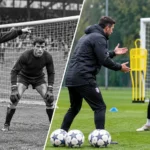
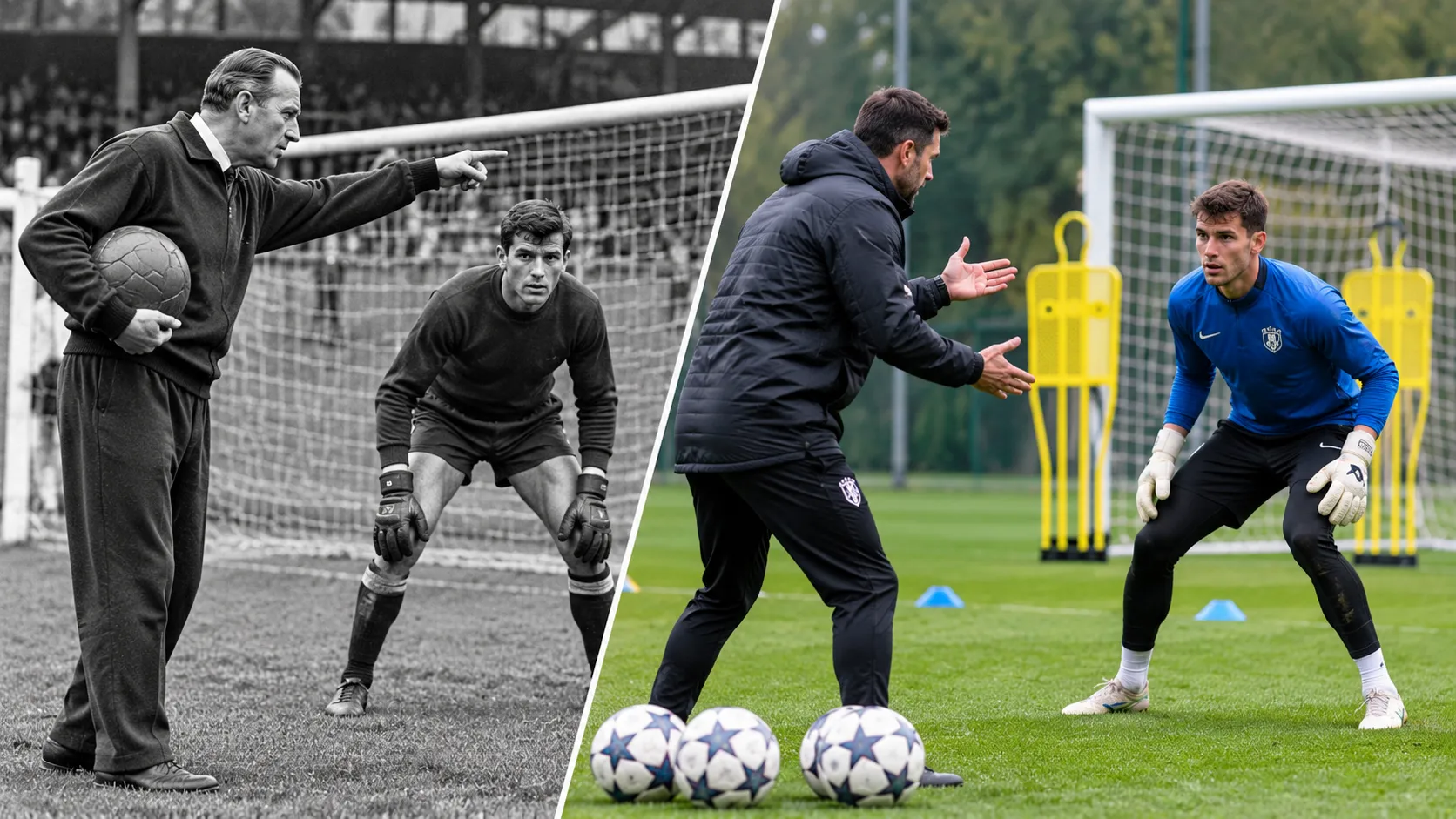
The position has been rebuilt twice in thirty years, and the question of how goalkeeping coaching changed is really the story of two rule changes and one tactical shift that between them altered what the job is.
A goalkeeper trained in 1988 and one trained today are doing different work. The hands are the smaller part of it now.
Before the change
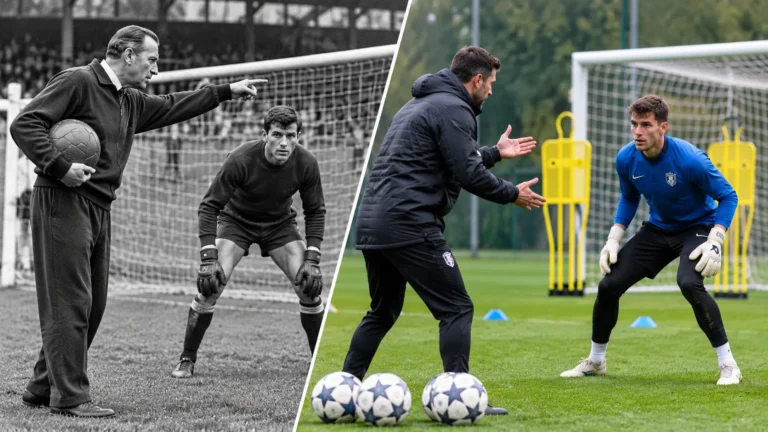
Goalkeeping was taught almost entirely as shot-stopping and aerial command. The training consisted of handling, diving, positioning for crosses, and distribution understood as kicking the ball a long way up the pitch.
Specialist coaching barely existed at most clubs. Goalkeepers trained with the outfield squad, did some extra handling work with whoever was available, and learned the position largely from the goalkeeper ahead of them.
The reason the job was simpler was that the laws permitted it. A goalkeeper could pick up a ball passed to him by a teammate, which meant a defence under pressure had a guaranteed way to stop the game, and the keeper never had to play out of anything.
The backpass law
In 1992 the laws were changed to prevent a goalkeeper handling a ball deliberately kicked to him by a teammate. It is the single most consequential rule change in modern football and it transformed the position overnight.
Suddenly a keeper needed to control a ball with his feet, under pressure, in his own six-yard box, with a forward closing. Goalkeepers who had spent fifteen years never needing that skill had to acquire it in a season, and several very good ones never did.
The second change came in 1997, when the restriction on how long a keeper could hold the ball was reframed as a six-second limit. Combined with the backpass law, it removed the last reliable way of taking the pace out of a match.
Why distribution became the priority
Because playing out from the back became a tactical orthodoxy, and the goalkeeper is the first player in that sequence. A side that builds from its own penalty area needs a keeper who can receive under pressure, choose between options, and pass accurately at range.
That has changed recruitment entirely. A goalkeeper who stops shots well and distributes poorly is now a limitation on the system, and clubs playing a possession-based game will pick the better footballer over the better shot-stopper.
It has also changed training. A modern goalkeeping session includes receiving with both feet, playing short under pressure, switching play with a long diagonal, and making decisions about when to go long work that would have been unrecognisable in a session thirty years earlier.
What does a goalkeeping coach actually do now?
At a well-resourced club, a great deal more than handling drills. The role covers technical work, positioning, decision-making, distribution, set-piece organisation and the specific preparation for individual opponents.
It also covers the analysis side. Shot-stopping is now measured against the difficulty of the shots faced, which gives a far better picture of performance than a save percentage, and a coach is expected to understand and use it.
Larger clubs employ more than one specialist, dividing the work between the first team and the academy, and frequently including a separate analyst. The position has gone from being coached incidentally to being the most individually coached role in the squad.
The sweeper-keeper question
The most visible modern development and the most risky. A goalkeeper positioned high, outside his area, acting as an extra defender, allows a side to defend a higher line and compress the pitch.
The cost of an error in that position is total. A keeper caught out thirty yards from goal concedes, and the mistakes are spectacular and endlessly replayed, which is why the approach generates more argument than any other aspect of the modern game.
The sensible reading is that it is a system requirement rather than a preference. A side defending with a high line needs the space behind it covered by somebody, and the only player available is the goalkeeper. Positions have been reshaped by tactical change before, as set out in why some football positions disappeared.
What has not changed?
Shot-stopping still decides matches. For all the emphasis on distribution, the measurable contribution of a goalkeeper to results remains dominated by whether he saves the shots he faces.
Aerial command still matters, and arguably more than it did, because set pieces have become a larger share of goals. A keeper who cannot deal with crosses is a problem no amount of passing range compensates for.
And the psychological demand is unchanged. It remains the only position where a single error produces a goal with no possibility of recovery, and the temperament required to play it has never been coachable.
The second-choice problem
A consequence of everything above that clubs still have not solved. A reserve goalkeeper may play three matches a season, and keeping him sharp is a genuine technical difficulty.
Outfield substitutes get minutes. A goalkeeper does not, unless the first choice is injured or suspended, which means a professional training every day with no competitive football for months at a time. Match sharpness in the position depends on handling live shots under pressure, and no session reproduces it.
The approaches clubs use are all imperfect. Loaning the second choice out solves his sharpness and leaves the club exposed. Playing him in cup competitions keeps him involved and costs the first choice rhythm. Rotating in the league is rare and unpopular with everybody.
Most clubs settle for accepting the problem and signing an experienced second choice who can handle a cold start, which is why the role is one of the few in football where being thirty-four is an advantage rather than a concern. Experience of starting cold is itself a skill, it is one only a long career teaches, and it is why clubs will sign a veteran second choice rather than promote a promising youngster into the role.
How it affects young goalkeepers
The pathway has narrowed. A club needs one senior goalkeeper and perhaps two others, which means academies produce far more outfield professionals than keepers, and the competition for the few places is severe.
It has also raised the technical bar for entry. A fourteen-year-old goalkeeper who cannot pass is now unlikely to progress at a serious academy, regardless of how well he handles, which was not true a generation ago.
The compensation is a longer career. Goalkeepers peak later than outfield players and continue well past the point at which a winger is finished, so the narrow pathway leads to a longer stay once you are through it. The facilities that pathway runs through have changed enormously too, which is the subject of why football clubs build new training grounds.
Frequently asked questions
What was the backpass law change?
In 1992 goalkeepers were prohibited from handling a ball deliberately kicked to them by a teammate. It forced keepers to develop footwork and is the most consequential modern rule change.
Why is distribution now so important?
Because playing out from the back became tactical orthodoxy, and the goalkeeper is the first player in that sequence. Clubs now weigh passing ability heavily in recruitment.
What is a sweeper-keeper?
A goalkeeper positioned high, often outside his area, covering the space behind a high defensive line. It is a system requirement rather than a stylistic choice.
Do goalkeepers still get judged on saves?
Yes, and it remains the largest measurable contribution to results now assessed against the difficulty of the shots faced rather than a raw save percentage.
About the Author