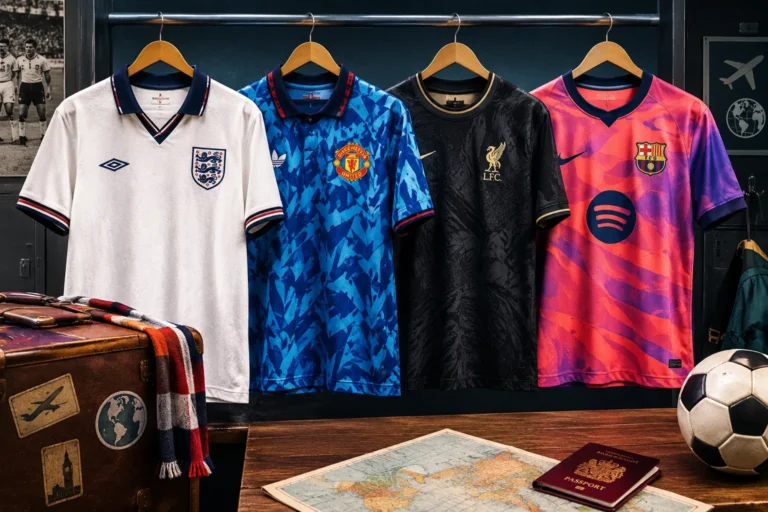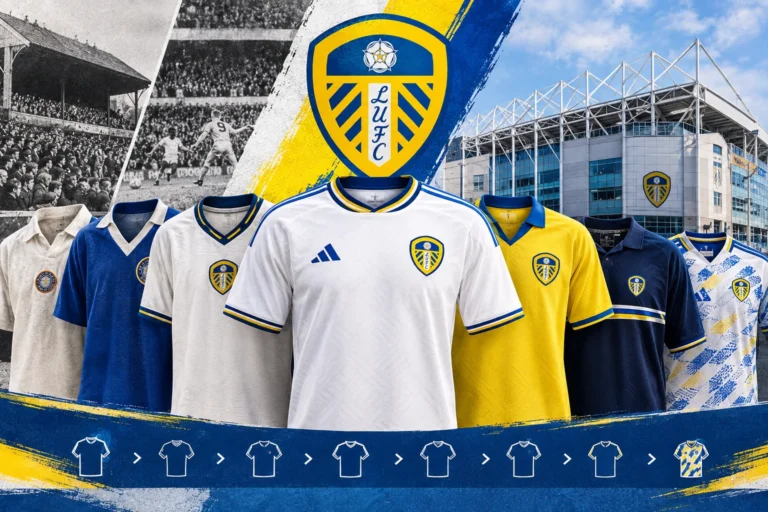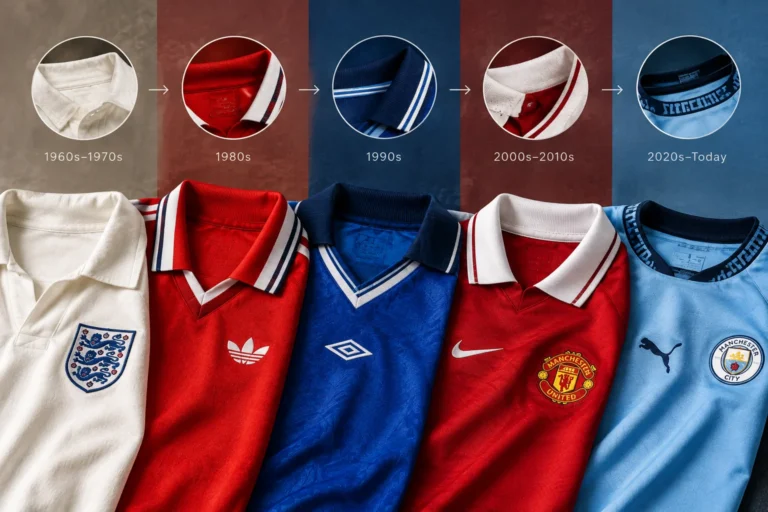




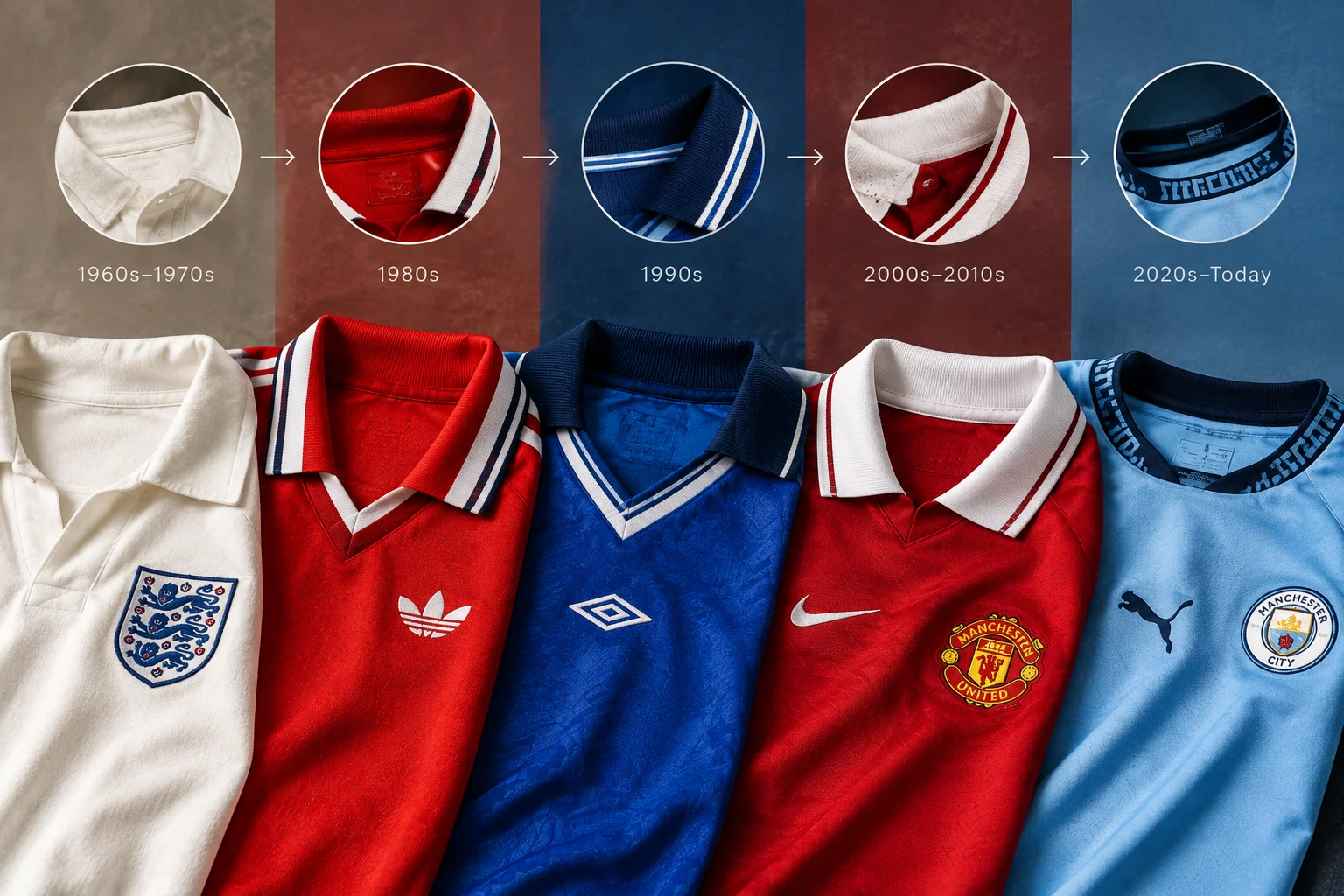
Of all the parts of a football shirt, the collar is the one that changes most often and gets noticed least. Colours stay fixed for a century. Crests are redrawn every decade or two. The collar changes every few seasons, and because it does, it is the single most useful clue for placing a shirt in its era.
Its history is also a small history of the game itself.
What did the earliest collars look like?
Like ordinary shirts of the time, because that is what football shirts were.
Nineteenth-century football shirts were adapted from everyday clothing: heavy cotton or wool, with a collar and a laced or buttoned front like a work shirt. The lace-up neck, with a cord threaded through eyelets, was common through the early decades of the professional game and is now one of the clearest signs of a pre-war or early post-war shirt.
Those collars were practical rather than decorative. The lacing allowed the shirt to be pulled over the head and tightened, in fabric that had little give.
When did the collar become a design element?
Through the middle of the twentieth century, as shirts became lighter and manufacturers began to think about how they looked.
The lace-up neck gave way to buttoned collars and then to simpler designs as fabrics improved. By the 1960s, round necks and V-necks had appeared, offering a cleaner look and a lighter shirt. From that point the collar was a choice rather than a necessity, and different clubs and manufacturers made different ones.
That is when the collar became useful for dating. Once it was a choice, it changed with fashion, and fashion moves fast.
Why do collars change so often?
Because they are the cheapest thing on a shirt to alter.
Changing a club’s colours is unthinkable. Changing the crest is a major decision. Changing the collar costs almost nothing and gives a new season’s shirt a visibly different look without touching anything supporters care about. Manufacturers use it as the main way of refreshing a design each year, which is why two home shirts from consecutive seasons often differ in the collar and almost nothing else.
For the same reason, the collar is where manufacturers put their house style. A given manufacturer’s shirts across many clubs in the same season frequently share a collar, because they share a template.
What are the main collar eras?
Roughly, and with plenty of overlap.
Lace-up necks belong to the early decades. Buttoned collars ran through the mid-century. The 1970s brought long pointed collars that followed the fashion of the time. The 1980s and 1990s saw V-necks with contrasting trim, round necks, polo-style collars with buttons, and some elaborate constructions that are now instantly recognisable. Modern shirts favour minimal round necks or low V-necks, often with bonded rather than stitched construction, driven by the search for lighter, more aerodynamic fabric.
Retro revivals complicate the picture, since modern shirts sometimes deliberately copy older collar styles. But the construction usually gives them away.
Do goalkeeper shirts follow the same collar fashions?
Loosely, and with a lag.
Goalkeeper shirts have historically been made in heavier fabric with padding, and their collars have tended to be more substantial than outfield ones. They often kept a polo collar or a high neck after outfield shirts had moved to minimal designs, partly for warmth and partly because goalkeepers stand still for long periods. That lag makes the goalkeeper’s collar a slightly different dating tool from the outfield one, and a goalkeeper shirt with an unusually modern neck for its claimed era is worth a second look.
How does the collar help date a shirt?
By narrowing a shirt to a season or two once the era is known.
The manufacturer’s logo and the sponsor place a shirt within a block of years. The crest narrows it further. But within a sponsorship period, several seasons may share those three markers, and the collar is what separates them. A club that used a round neck one season and a V-neck with trim the next has given collectors an easy way to tell the two apart.
Our piece on Tottenham’s white shirt and the cockerel shows how much work the collar does on a shirt where the colour never changes.
What about national team collars?
They follow the same fashions but change less often, because international shirts run on tournament cycles rather than seasons.
A national team’s collar might stay the same for two years or more, which makes it a broader marker than a club collar. Within that, the same rules apply: the collar separates cycles within a manufacturer’s period, and a distinctive collar on an international shirt places it to a specific tournament in a way that a plain one cannot.
Why do supporters argue about collars?
Because they notice them more than they realise.
A collar that departs sharply from what supporters are used to draws complaints out of proportion to its size. Polo collars on a club known for round necks, or a high collar on a club known for open ones, produce reactions that suggest the collar carries more identity than anyone admits. Some clubs have reversed collar changes after a season because of the response.
The collar is also where a shirt meets the face, which may be why people feel strongly about it.
Which collars became iconic?
The ones that broke the pattern, usually.
A few collars have become so associated with a particular season or club that they are recognisable on their own: certain large polo collars of the early 1990s, particular V-neck-and-trim combinations, the lace-up revivals that some clubs used for anniversary shirts. Manufacturers know this, which is why retro-inspired shirts so often reach for a collar from a famous era first. The collar carries the memory even when the rest of the shirt is modern.
What has modern fabric done to the collar?
Simplified it, mostly.
Modern performance fabrics are light and stretchy, and a heavy constructed collar fights against that. Manufacturers have moved towards minimal necklines, often bonded rather than sewn, that add as little weight and bulk as possible. The elaborate collars of the 1990s would be difficult to build in modern fabric and would defeat the purpose of it.
That has made recent shirts harder to distinguish by collar than older ones, which shifts the dating work back towards the crest and the manufacturer’s mark.
Next time you look at an old shirt and cannot place it, start at the neck. The colours will tell you the club and the crest will tell you the decade, but it is the collar that will tell you the season.
Frequently asked questions
Why do football shirt collars change every season?
Because the collar is the cheapest element to alter and gives a new shirt a visibly different look without changing colours or crest.
What collar did old football shirts have?
Early shirts used lace-up necks with a cord through eyelets, followed by buttoned collars through the mid-twentieth century.
Can you date a football shirt by its collar?
Often to within a season or two, once the era is known from the manufacturer’s logo, sponsor and crest.
About the Author