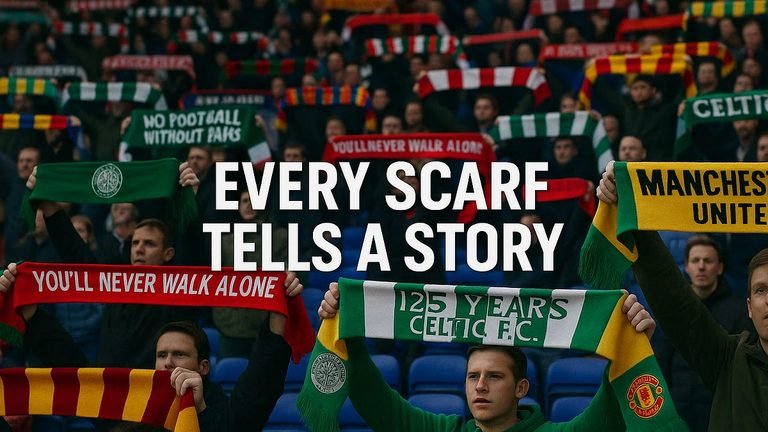

Most of what supporters wear to a football match has been designed, licensed and sold to them. The scarf is the exception. It arrived in the game before replica kits existed, before clubs had merchandising departments, and before anyone thought of a crowd as a market, and it is the one item of supporter culture that was genuinely made by supporters first.
Its history is also a reasonable history of the English crowd — what it wore, how it identified itself, and how a homemade object became a product.
Victorian colours and the rosette
Early football crowds did not dress in club colours at all. Photographs from the end of the nineteenth century show caps, overcoats and very little that would identify which side a man supported. What identification there was came from the rosette: a circular pleated ribbon badge in club colours, pinned to a lapel, borrowed directly from horse racing and from political campaigning.
Rosettes were sold outside grounds by independent traders, and they survived as the dominant supporter item well into the twentieth century. They are worth remembering because they establish the pattern that everything after them followed — a small, cheap, unofficial object made by somebody with no connection to the club, bought on the way in.
Where did the football scarf come from?
The scarf itself arrived through a different route: the universities and the sports clubs of the Victorian period, where striped or barred scarves in institutional colours were standard. Football clubs adopted colours for their shirts, and supporters who wanted to show those colours did the obvious thing.
Crucially, early football scarves were knitted at home. A club playing in claret and blue produced a generation of supporters whose mothers and grandmothers knitted claret and blue scarves, which is why old photographs show enormous variation in width, pattern and quality within a single crowd. There was no standard because there was no manufacturer.
That changed slowly through the middle of the twentieth century as small firms began producing scarves commercially, but the homemade scarf persisted much longer than you might expect, and a well-made one lasted decades.
The bar scarf and the terrace era
What most people picture as a football scarf — horizontal bands of two or three colours, with a fringe at each end — is the bar scarf, and it became the standard design in the post-war period. It is cheap to produce on a loom, it works in any combination of colours, and it is instantly readable from a distance.
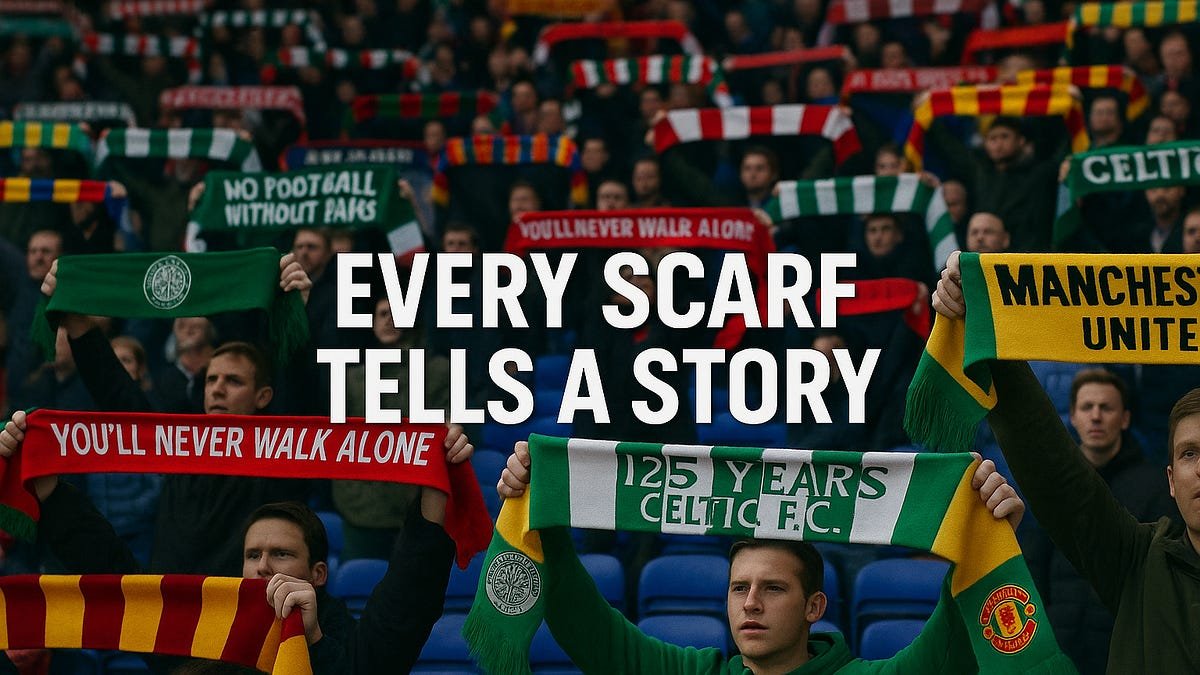
On a terrace, the scarf was functional as well as decorative. It kept you warm standing still in February, it could be held up over the head in a block of thousands to produce a wall of colour, and it could be twirled, which is how it became part of the choreography of singing. The images of massed scarves held aloft during a song are from this period, and the practice spread between clubs and between countries.
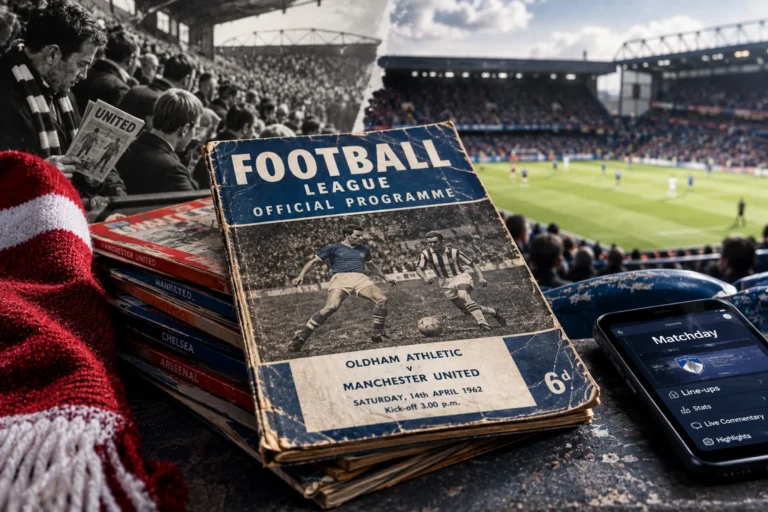
Scarves also carried information. Supporters sewed on patches, pinned badges to them, and added the names of grounds they had visited, which turned a scarf into a record of a supporting life. Some of the best objects in football museums are scarves covered in forty years of accumulated metal badges. The same instinct produced the collecting culture around programmes, which we cover in the matchday programme.
Why did clubs take the scarf over?
Because it worked, and because by the nineteen-eighties clubs were beginning to understand that supporters would buy things. Official club shops started selling scarves alongside replica shirts, and the official product displaced much of the independent trade outside the ground.
Design followed. Clubs introduced scarves with crests woven in, with slogans, with anniversary dates and with sponsor logos, and the simple bar scarf became one option among many. The quality generally improved and the variation decreased, which is the usual trade when something becomes an official product.
The independent trade did not disappear, and it still occupies the pavements outside most English grounds. What it sells has changed: unofficial scarves now tend to carry slogans, nicknames and in-jokes that a club could not or would not put its name to, which is arguably closer to the original spirit of the thing than the club shop version.
The half-and-half argument
The half-and-half scarf — one club’s colours on one side, the opponent’s on the other, usually with the date and the fixture — is the most contested object in modern football merchandising. It arrived in England relatively recently, having been common in continental Europe for years, and it is sold outside grounds before big matches.
The objection to it is straightforward: a scarf is supposed to declare an allegiance, and a scarf displaying both sides declares none. For many supporters it is a tourist item, a souvenir of attendance rather than a statement of support, and its spread is taken as evidence of a crowd changing character.
The defence is also straightforward. A commemorative object marking a specific match is a perfectly normal thing to want, people have bought souvenirs at football for well over a century, and the rosette sellers of 1900 were no more authentic than the scarf sellers of today. Both arguments are made with great feeling outside every major fixture, and neither is going to win.
Scarves as objects worth keeping
A scarf is one of the few football items that improves with age. A replica shirt from twenty years ago looks dated; a bar scarf from twenty years ago looks exactly like a bar scarf, because the design barely moves. That stability is why old scarves turn up in such quantity and why collectors take them seriously.
The ones with real value are usually the commemorative issues from specific matches, the early machine-woven examples from small firms that no longer exist, and the homemade ones, which are by definition unique. Condition matters less than you would expect, because a scarf that has obviously been worn to hundreds of matches is more interesting than one that has sat in a drawer.
What to look for in a good scarf
If you are buying one to keep, the things that matter are the fibre, the weave and the finish. Acrylic is warm, cheap and holds colour well; wool is warmer and ages better but shrinks if washed carelessly. A jacquard weave, where the pattern is woven through the scarf, will outlast a printed one by many years.
Check the ends. A properly finished scarf has a knotted or neatly sewn fringe that will not unravel, and the fringe is the first thing to fail on a cheap one. And check the reverse: on a well-made scarf the back is a clean negative of the front, while on a poor one it is a mess of loose threads.
Frequently asked questions
Which came first, the scarf or the replica shirt?
The scarf, by a very long way. Supporters wore club colours as scarves and rosettes for decades before replica shirts were produced for sale.
Why are football scarves striped horizontally?
The bar scarf design is cheap and quick to weave, works with any colour combination and is readable from a distance, which made it the standard once scarves began to be produced commercially.
Are half-and-half scarves a new thing?
In England, relatively — they became common in the last couple of decades, having been established in continental Europe earlier. Commemorative match souvenirs themselves are much older.
How should I wash a football scarf?
Cold water by hand, and dry it flat. Acrylic tolerates a cool machine wash; wool will shrink and felt if it gets warm or is agitated. The same care logic applies to older shirts, which were made from very different materials, as how football shirts were made before polyester explains.
About the Author