


Every July the same arguments happen, and they happen because supporters and coaching staff are watching pre-season for different reasons. Understanding what a football pre-season is actually for removes most of them.
It is not a series of matches with results worth analysing. It is six weeks of physical preparation with some football attached, and the football is arranged around the preparation rather than the other way round.
The physical purpose
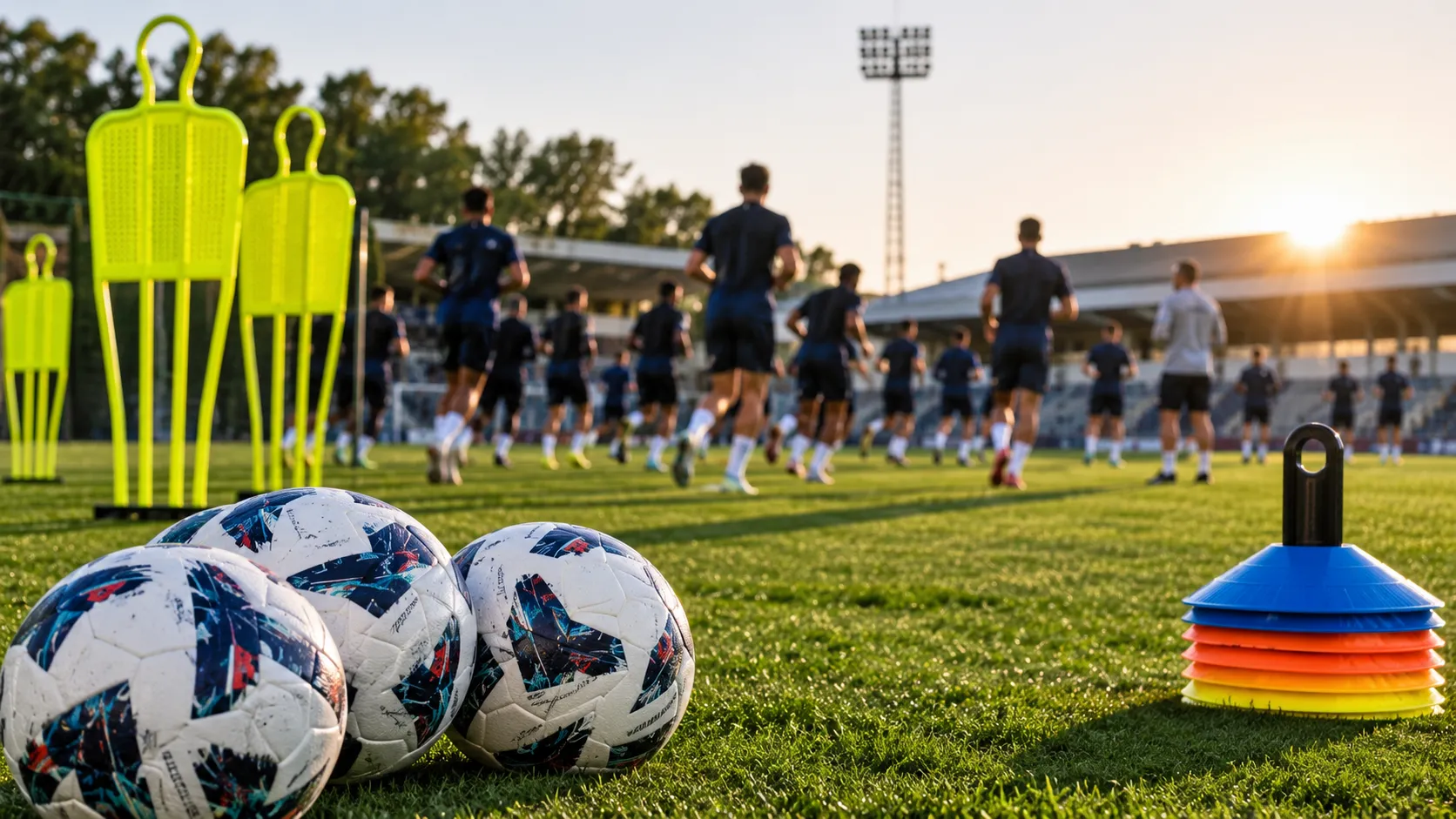
The primary job is rebuilding an aerobic base that has partially decayed over a short off-season. Players return having done maintenance work rather than training work, and the first ten days are about restoring capacity before any serious intensity is possible.
That sequence matters and cannot be shortened. Loading a player with high-speed running before the base is rebuilt is the single most reliable way to produce a soft-tissue injury, which is why the opening sessions look slow and unexciting to anyone watching.
From roughly the second week the work shifts towards intensity repeated sprints, change of direction, the specific demands of each position. By the final fortnight the physical work is tapering and the emphasis has moved to match readiness.
The tactical purpose
Pre-season is the only block in the calendar with enough consecutive days to teach something new. During the season a coach gets two or three sessions between matches, most of which are recovery or preparation for a specific opponent.
So this is when structural work happens: a change of shape, a different pressing scheme, new patterns from set pieces. A manager who wants to change how his side plays has to do it in July or wait a year.
It is also when new signings are integrated, which is a slower process than supporters expect. A player learning an unfamiliar system needs weeks of repetition before the movements become automatic, and a signing who arrives in late August is behind in a way that persists into the autumn.
Why are the results meaningless?
Because the conditions bear no relation to a competitive match. Teams make eleven changes at half time, play players in unfamiliar positions, and prioritise giving everyone minutes over winning.
Fitness levels are also deliberately asymmetric. A side three weeks into pre-season playing one that is five weeks in will be outrun regardless of quality, and the scoreline reflects the training calendar rather than anything about either team.
Then there is intent. Nobody tackles properly in a friendly, nobody presses at full intensity for ninety minutes, and both managers are content with a draw. A result produced under those conditions predicts nothing, which is why heavy pre-season defeats are routinely followed by good starts and vice versa.
The commercial purpose
The part that is least popular and hardest to avoid. Overseas tours generate substantial commercial income, build the supporter base in growth markets, and service sponsor obligations that are written into contracts.
The cost is real. Long-haul travel, time-zone disruption and matches played in heat and humidity all interfere with the physical programme, and sports science departments generally regard a tour as something to be managed rather than something that helps.
The compromise most clubs reach is to tour in the middle of pre-season, with the base work done at home beforehand and the sharpening done at home afterwards. The tour becomes the tactical and commercial block rather than the conditioning one.
What to actually watch for
Minutes rather than results. Which players are getting sixty minutes in the final two matches tells you who the manager expects to start, and it is far more informative than any scoreline.
Watch for positional changes as well. A full-back appearing in midfield across several matches is a plan rather than an experiment, and these are often the clearest signal of how a side will be set up.
And watch who is absent. A player who misses the whole of pre-season through injury will not be fit in any meaningful sense until September, regardless of what the club says about his availability, because the base work cannot be compressed.
How long should it be?
Longer than most clubs get, which is the structural complaint. Six weeks is the traditional figure and very few squads get a clean six weeks because of international tournaments, late finishes in continental competition and early-season qualifying rounds.
Players returning from a summer tournament may get two or three weeks of holiday and join pre-season halfway through, which means they are physically behind for the opening months of the season. Managers routinely manage these players separately, and it is why a star signing can look ordinary in August.
The compression has worsened as the calendar has filled. A season that ends in late May and begins in early August leaves no room for both recovery and preparation, which is the recurring issue behind why English football has no winter break as well.
The friendly opponents tell a story
Who a club plays, and in what order, is a planning decision rather than a scheduling accident. The sequence almost always runs from weak to strong.
Early fixtures are against lower-division or amateur opposition, played in two halves of forty-five minutes with entirely different teams, at a controlled intensity. These are training sessions with a crowd, and the opponent is chosen because they will not injure anybody.
The middle block steps up to serious but not elite opposition, often on the tour. The final fixtures are against sides of comparable standard, played with a settled eleven for sixty or seventy minutes, because the point by then is match sharpness rather than fitness.
A club that has arranged a difficult fixture for its first match back has either been forced into it by a tournament commitment or has made a mistake, and the injury record afterwards usually shows which.
What a good pre-season looks like
Everyone available by the final week. Injury-free completion is the actual measure of success, and a squad that reaches the opening fixture with no soft-tissue problems has had a good six weeks whatever the friendly results were.
Clear role definition. By mid-August the players should know what they are being asked to do and the shape should look settled, even if the personnel are not.
And a sensible final fixture a competitive opponent, a full-strength side, ninety minutes at proper intensity. That match is the only pre-season game with any diagnostic value, and it is the one to watch if you are only watching one. Behind all of it sits a planning structure that most supporters never see, which is the subject of how football agents actually work at the recruitment end.
Why the first weeks of the season look scrappy
Because pre-season cannot replicate competitive football, however well it is run. Nothing in July reproduces the intensity of a match that matters, and the gap shows for a fortnight.
Match fitness and training fitness are different things. A player can complete every session, hit every physical target and still be half a yard off the tempo of a league fixture, because that tempo involves decisions made under pressure rather than output measured in a controlled session.
This is why August tables are unreliable and why early results correct so sharply. Sides that started pre-season early, or had fewer internationals, or avoided a long tour, hold an advantage that has disappeared entirely by October.
It is also why managers are cautious about judging new signings in the opening weeks. A player who looks a yard short in August is frequently a player who has not yet had six competitive matches, and the ones who are genuinely struggling do not become apparent until the clocks change.
Frequently asked questions
Why are pre-season results irrelevant?
Because teams make wholesale changes at half time, play people out of position, and are at deliberately different fitness levels. The conditions bear no relation to a competitive match.
How long is a normal pre-season?
Around six weeks, though very few squads get a clean six because of international tournaments and early continental fixtures.
Why do clubs tour abroad if it disrupts training?
Commercial income and sponsor obligations. Most clubs compromise by doing conditioning work at home and using the tour for tactical and commercial purposes.
What is the best thing to watch in pre-season?
Minutes and positions. Who plays sixty minutes in the final two matches, and where, tells you far more than any scoreline.
About the Author