




A modern football shirt weighs about as much as a paperback and is engineered to move sweat away from the skin. For the first seventy years of organised football, the shirt was closer to a jumper: knitted from wool or heavy cotton, long-sleeved, collared, and capable of absorbing an extraordinary amount of water.
The change from those garments to the synthetics of today was not a single moment but a series of steps, and each one was driven by a specific problem with what came before.
What did wool jerseys do in the rain?
The earliest football jerseys were knitted wool, in the same tradition as the rugby and cricket garments of the period. Wool is warm, it holds its shape, and it was what knitting mills in the north of England produced.
It is also absorbent. A wool jersey in heavy rain could take on a very large proportion of its own weight in water, and the consequence was not subtle: by the second half of a wet match a player was carrying a significantly heavier garment than the one he started in, soaked through, with sleeves stretched by the weight. Accounts from the period describe players cutting sleeves off at half time.
The pitches made it worse. Before modern drainage, a winter pitch in England was mud for months, and a wool shirt covered in it was heavier still. This is the context for everything that followed — the entire history of football shirt technology is, at bottom, a history of trying to get the weight down.
Heavy cotton and the laced collar
Cotton replaced wool gradually through the early twentieth century, and it was a genuine improvement: lighter when dry, cheaper, easier to dye in strong colours and easier to wash. It was still substantial material by modern standards, more like a heavy rugby shirt than a modern top.
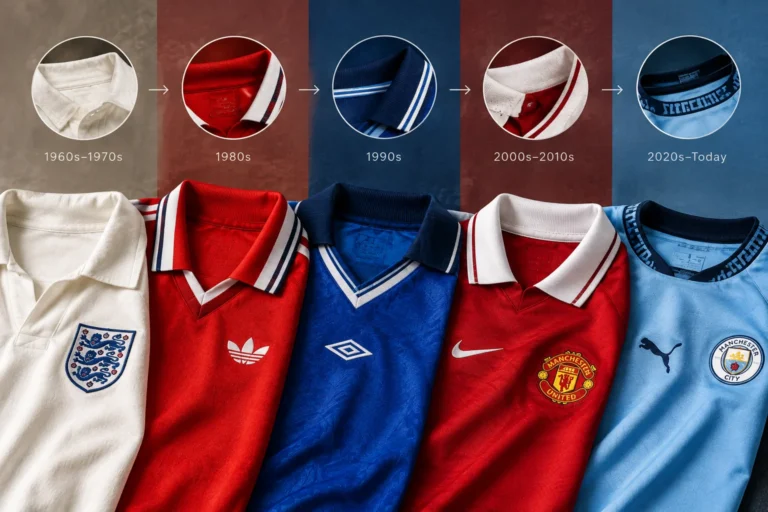
This is the era of the laced collar, which is the detail most people associate with early football. The lacing was practical rather than decorative — it allowed the neck opening to be adjusted and closed, on a garment that was pulled over the head and had no other fastening. As collar construction improved, the lacing disappeared, surviving only as an occasional retro design flourish. We cover that evolution in more detail in how the football shirt collar changed.
Cotton shirts also set the template for how shirts were cut: generous through the body, long in the sleeve, loose at the cuff and long at the hem, because the material had limited stretch and needed room to allow movement.
How shirts were actually produced
The manufacturing side is worth a paragraph, because it explains the regional geography of English football kit. Knitting mills in Lancashire, Yorkshire and the Midlands supplied the trade, and the firms that made football jerseys generally made other knitted goods as well — underwear, hosiery, sportswear for cricket and rugby.
Clubs bought from whoever was local and cheap, which is why there was no visual consistency between clubs beyond their colours, and why there was no such thing as a kit supplier in the modern sense. A club ordered a batch of shirts to a specification it set itself, and the maker’s name appeared nowhere on the garment. Branded kit, with a manufacturer’s logo visible on the chest or sleeve, is a development of the nineteen-seventies and later.
That also explains why dating a pre-war shirt is so difficult. With no maker’s mark, no sponsor and often no badge, the only evidence is the cut, the material and the collar.
The nineteen-fifties and the influence from abroad
The visible shift in shirt design came in the middle of the century, and the trigger was international football. Teams arriving in England from Hungary, Brazil and elsewhere wore noticeably lighter, shorter-sleeved, more closely cut kit, and they wore lighter boots to match.
The effect was partly practical and partly psychological. English clubs began moving to lighter cotton, short sleeves became an option rather than an oddity, and the baggy cut started to come in. By the end of the nineteen-fifties a football shirt looked recognisably like a modern garment, even though the material had not fundamentally changed.
What did synthetics actually change?
Nylon and then polyester arrived in football kit through the nineteen-sixties and seventies, and the first consequence was weight. A synthetic shirt was dramatically lighter than cotton, dried far faster, held printed and applied graphics better, and could be produced in sharper, more stable colours.
The second consequence was less welcome. Early synthetics did not breathe. A nylon shirt kept the rain out and kept the sweat in, which is why photographs from that period show players soaked through in dry weather. The fabric solved the water problem from outside and created one from inside.
Fixing that took another two decades and produced the mesh panels of the nineteen-eighties — the Airtex-style ventilated inserts under the arms and across the back that are such a strong visual marker of that era. They were an engineering solution to a real problem, not a style choice, and they worked well enough that ventilation has been part of shirt design ever since.
The modern answer is a knitted polyester engineered to pull moisture along the fibre and spread it across the surface, so it evaporates rather than sitting on the skin. That is the technology the word “wicking” refers to, and it is the end point of a century of trying to stop a shirt getting heavy.
Why the old shirts are worth understanding
Partly because it changes how you read old footage. A player moving slowly through mud in a soaked jersey in 1955 was doing something physically harder than a modern player covering more ground on a dry pitch in a 140-gram shirt, and the comparison between eras is not as simple as the statistics make it look.
It also explains why reproductions of old shirts are difficult to get right. A faithful reproduction has to use heavier material with a visible weave, a specific collar construction and a boxier cut, and all three cost money. A cheap retro shirt is a modern synthetic blank with an old design on it, and it feels nothing like the original, which is the main thing collectors learn to check for.
Frequently asked questions
What were the first football shirts made from?
Knitted wool, in the same tradition as other Victorian sporting garments. Heavy cotton replaced it gradually through the early twentieth century.
Why did old football shirts have laced collars?
The lacing allowed the neck of a pull-on garment to be adjusted and closed. It was functional, and it disappeared once better collar construction became available.
Did early shirts really get much heavier in the rain?
Yes. Wool and heavy cotton absorb a great deal of water, and a soaked jersey was substantially heavier than a dry one, with sleeves stretched by the weight.
Why do eighties shirts have mesh panels?
Because early synthetics did not breathe. Ventilated inserts under the arms and across the back were an engineering fix for sweat trapped against the skin. Club names record their own history too, as why football clubs are named the way they are explains, and colours came with theirs, as why football clubs wear the colours they do sets out.
About the Author