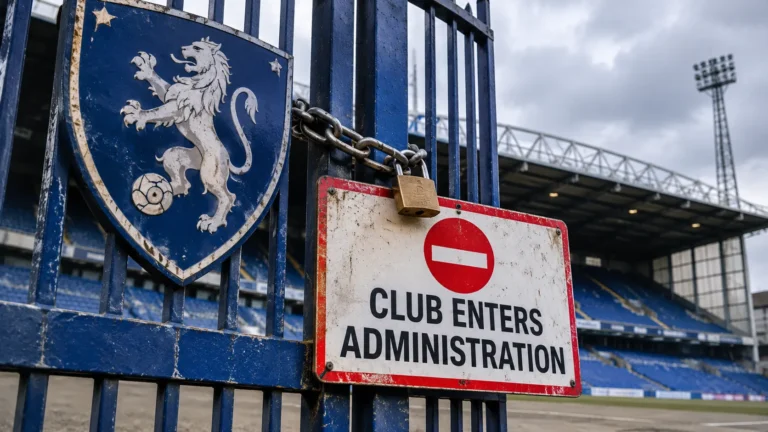



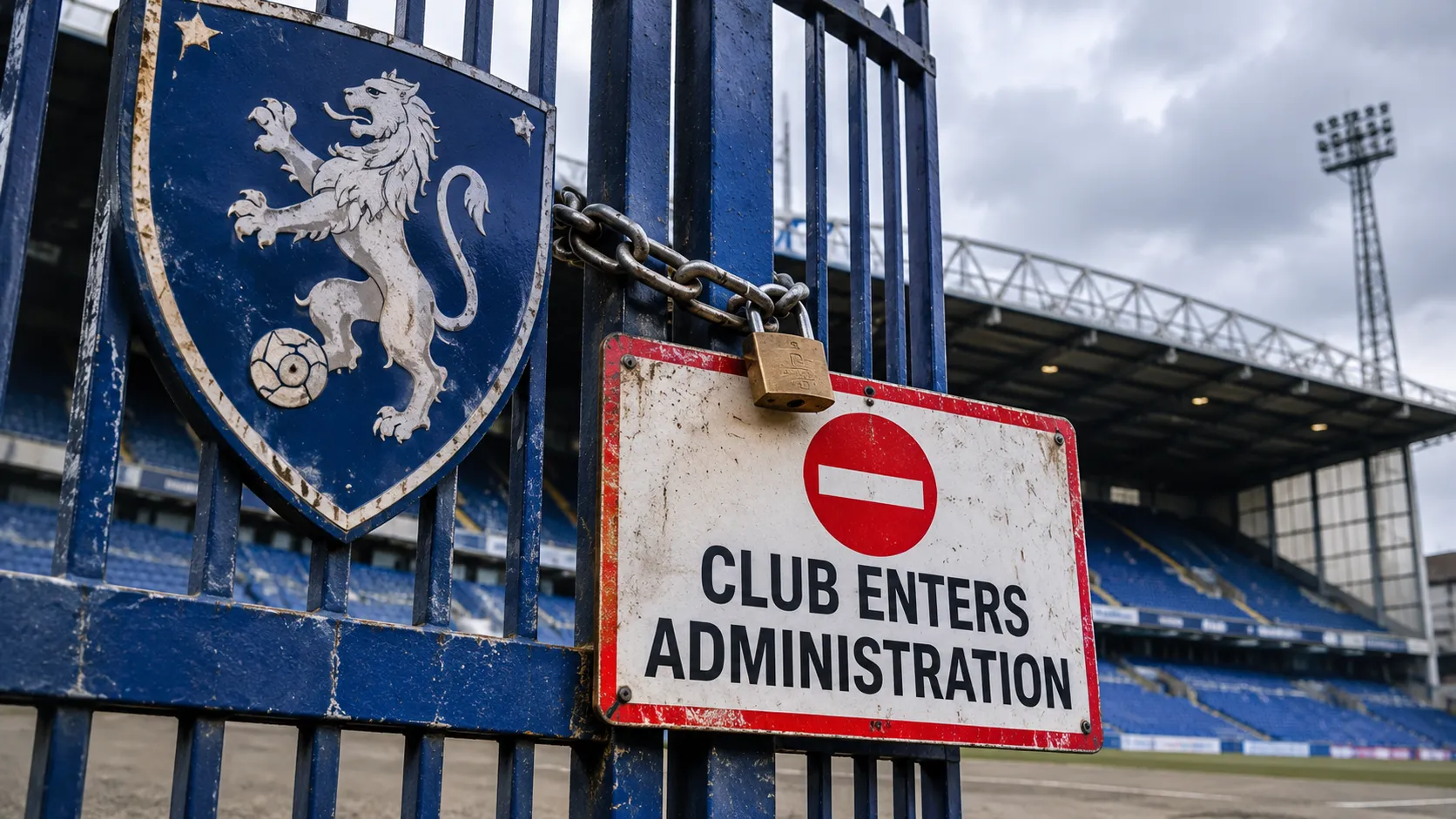
Working out what happens when a football club goes into administration is worth doing before it happens to yours, because the sequence is well established and the outcomes are more varied than the headlines suggest. Some clubs enter administration, take their punishment and recover. Others are liquidated and re-formed in a lower division. A few disappear.
The difference between those outcomes is rarely about the football and almost always about who is owed money and what they will accept.
What administration actually is
A legal process for an insolvent company. An administrator is appointed, takes control from the directors, and has a duty to try to rescue the business or, failing that, to get the best outcome for creditors.
For a football club the rescue usually means finding a buyer and agreeing a settlement with creditors, because the alternative is liquidation and the end of the company. The administrator runs the club in the meantime, which in practice means paying the wages that have to be paid and cancelling everything that does not.
Supporters typically experience it as a sudden freeze: no transfers, players sold cheaply, staff made redundant, and a stream of statements about ongoing discussions with interested parties.
The points deduction
Entering administration triggers an automatic sporting penalty, and in the English Football League that is currently a twelve-point deduction. The Premier League operates its own equivalent sanction.
The rationale is to remove the competitive advantage of spending money you cannot pay back. Without a penalty, a club could outspend its rivals, go into administration, write off the debts and keep the league position it bought so the deduction exists to make insolvency sporting as well as financial.
Timing matters enormously. A deduction applied in March to a club in mid-table is survivable; the same deduction applied to a club already in trouble frequently means relegation, which reduces income and makes the recovery harder. Administrators are aware of this and the timing of a filing is sometimes influenced by it.
Who gets paid, and in what order?
This is where football differs from ordinary business, and where most of the controversy sits. Football’s own rules have historically required that “football creditors” other clubs, players, league bodies be paid in full before a club can be readmitted to the competition.
The effect is that other football businesses recover their money while ordinary creditors frequently do not: local suppliers, the caterer, the printer, the tax authorities, St John Ambulance. That hierarchy has been challenged in court and criticised repeatedly, and the arrangements have been modified over time, but the basic tension remains.
The defence offered is that the competition cannot function if clubs do not pay each other, and that a club readmitted while owing money to its rivals distorts the league. The criticism is that it privileges football over the communities clubs claim to represent. Both arguments have force.
How does a club actually exit administration?
Usually through a company voluntary arrangement a CVA in which creditors agree to accept a proportion of what they are owed, often a small one, in exchange for the business continuing. If enough creditors by value agree, the club exits administration under new ownership with a reduced debt.
If a CVA cannot be agreed, the company is liquidated. The club as a legal entity ceases to exist, and what happens next depends on whether a new company can acquire the assets the ground, the name, the history and be admitted to a league.
That is the route by which clubs re-form and start again lower down, sometimes several divisions below where they were. The supporters, the colours and the name continue; the company does not. For how a club’s identity persists through all of this, see why football clubs are named the way they are.
Why it keeps happening
Because the incentives reward gambling. Promotion is worth so much more than consolidation, particularly into the Premier League, that clubs routinely commit to wages justified only by a promotion that may not arrive. When it does not, the gap has to be filled by an owner, and if the owner stops filling it the club is insolvent within months.
Ownership is the other half. A club dependent on one person’s continued funding is one argument, divorce or change of mind away from crisis, and the sale of a ground in a previous crisis removes the asset that might have saved it next time.
Financial regulations exist precisely to limit this, and they constrain the biggest clubs far more effectively than the smaller ones because the catastrophic risk sits lower down the pyramid, where the sums are small and the scrutiny is thin.
The clubs that did not come back
It is worth naming the outcome nobody likes discussing, because it happens. A small number of clubs have gone through insolvency and ceased to exist entirely no CVA agreed, no buyer found for the assets, no admission to a league for a successor company.
What follows is a town without a football club, and in most cases a supporter base that scatters to neighbouring sides rather than forming a replacement. Where a phoenix club is formed it typically starts many divisions down, with no ground of its own and a long climb that most do not complete.
There is also a legal wrinkle worth knowing. A club’s membership of a league its “share” or golden share, depending on the competition is a separate asset from the company, and it does not automatically transfer to a buyer. A successor company has to be admitted, and the league can refuse, which is the mechanism by which some clubs have been expelled rather than relegated.
The pattern in the cases that failed is consistent: a ground already sold or mortgaged, debts owed to parties with no interest in football continuing, and an owner who had removed the assets before the filing. Each of those is visible in advance to anyone reading the accounts, which is the strongest argument for supporters paying attention to a club’s finances long before a crisis. The colours and the name are what survive, as why football clubs wear the colours they do describes.
What supporters can actually do
Three things that have worked. Form a supporters’ trust early rather than during the crisis, because a trust with members and savings is a credible buyer and a trust formed in a panic is not. Protect the ground, through registering it as an asset of community value where that is possible, since a club without its ground has lost its only real asset.
And keep attending, which sounds sentimental and is commercial. A club with four thousand people still turning up is a business somebody might buy; a club with eight hundred is not. Several clubs that survived insolvency did so because the attendance held up through the worst of it. The structures that govern all of this are covered in what a sporting director actually does.
Frequently asked questions
How many points does a club lose for entering administration?
In the English Football League, currently twelve. The Premier League applies its own equivalent sanction.
What is the football creditors rule?
A requirement that other clubs, players and league bodies be paid in full before a club is readmitted to the competition ahead of ordinary creditors such as local suppliers and the tax authorities.
What is a CVA?
A company voluntary arrangement, in which creditors agree to accept a proportion of what they are owed so the business can continue. Without one, the company is liquidated.
Why do re-formed clubs start lower down?
Because the original company has been liquidated and a new one must be admitted to a league, usually well below the division the old club occupied.
About the Author