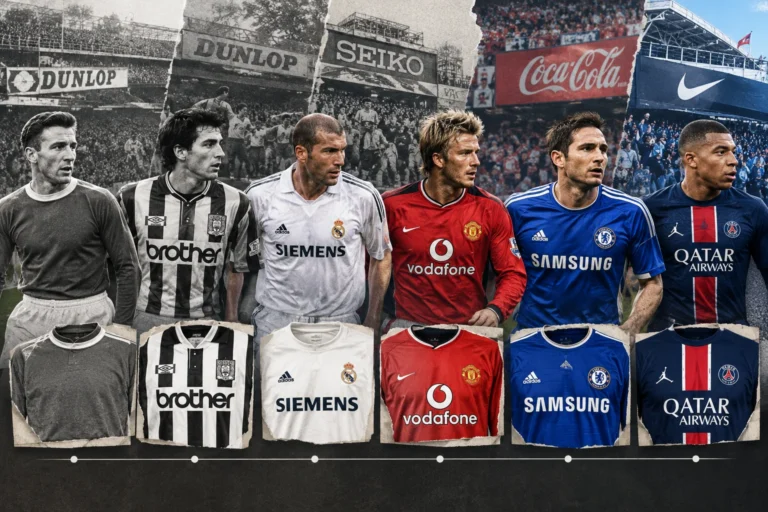


The name across the front of a football shirt is now so normal that an unsponsored shirt looks strangely bare. Yet for most of football’s history there was no sponsor at all, and when the first ones appeared they were resisted, restricted and in some cases banned from television. The story of how a company’s name came to sit above the crest is a story about football becoming a business, and it has left one of the most useful tools for dating an old shirt.
When did shirt sponsors arrive?
Later than people assume, and against resistance.
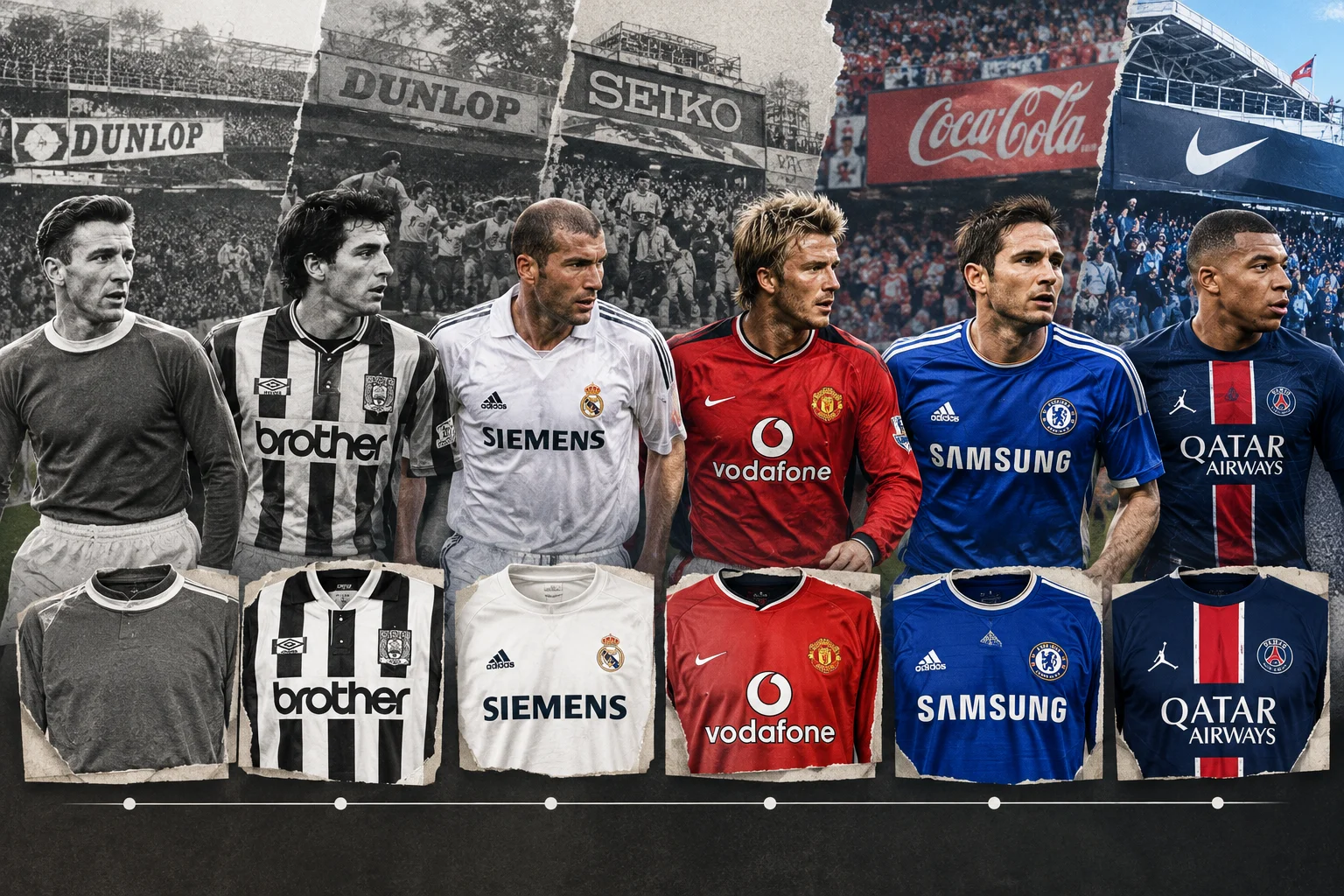
For most of the twentieth century, football shirts carried only the club crest and, eventually, the manufacturer’s mark. The front was otherwise blank. The first shirt sponsors appeared in English football in the late 1970s, and they were controversial immediately. The football authorities were wary of commercialising the shirt, and there were restrictions on the size of logos and, crucially, on whether sponsored shirts could be worn in televised matches.
For a period, clubs had sponsored shirts for ordinary matches and plain ones for television, which is why some shirts from that era exist in two versions.
Why was it resisted?
Because it felt like a line being crossed.
The shirt was the club’s identity, and putting a company’s name on it struck many at the time as a commercialisation too far. Broadcasters were reluctant to provide free advertising to sponsors by showing their logos, which is why the television restrictions existed. There was a sense that football was selling something it should not, and the resistance reflected a game not yet comfortable with becoming an industry.
That discomfort did not last. The money was too significant, and within a decade the restrictions had fallen away and sponsored shirts had become universal.
How did it become universal?
Through the money, which clubs could not refuse.
As the sums offered by sponsors grew, the arguments against them weakened. A club turning down shirt sponsorship was turning down income its rivals were taking, and the competitive pressure made resistance untenable. The television restrictions were lifted, logos grew larger, and by the 1990s every professional club carried a shirt sponsor as a matter of course. What had been controversial became unremarkable in a single generation.
The shirt had become advertising space, and one of the most valuable kinds, seen by everyone who watched the club play.
What did it change about the shirt?
The look, and the economics behind it.
Visually, the sponsor became a dominant element of the design, and designers had to work around it, balancing the crest, the manufacturer’s mark and the sponsor on the chest. Some shirts are remembered as much for their sponsor as their design, particularly those with unusual or striking company names.
Economically, the sponsor became one of a club’s most important sources of income, which changed how clubs thought about the shirt. It was no longer only the thing the team played in; it was a commercial asset to be sold, and that shift ran through everything that followed.
Were there sponsored shirts before the 1970s?
Not in the form we know, though advertising touched football earlier.
Advertising had appeared around football grounds, on hoardings and in programmes, long before it reached the shirt, but the shirt itself stayed clear of it until the late 1970s. The idea that the playing kit was not a place for advertising held for most of the game’s history, which is why the arrival of the first shirt sponsor felt like such a departure. The shirt had been one of the last advertising-free surfaces in a sport that was otherwise increasingly commercial, and once that surface was opened, it filled quickly.
Why does the sponsor help date a shirt?
Because sponsorship deals run in defined periods.
A shirt carrying a particular sponsor can only be from the seasons that company was on the front, which immediately narrows its era. Combined with the manufacturer’s mark, which changes on a different cycle, the sponsor usually places a shirt within a small range of seasons. Shirts from short-lived sponsorships are the easiest to date and often the most collectable, since they existed for only a season or two.
This is why collectors pay close attention to the sponsor, and why a sponsor that does not match the claimed season is a clear sign something is wrong with a shirt’s description. Our guide to dating a Leeds United shirt season by season covers how the sponsor fits alongside the other markers.
There is a lesson in it for anyone starting to read old shirts: look at the sponsor first. More than the design, more than the collar, the name on the front tells you where a shirt belongs in a club’s history, because it ties the shirt to a commercial relationship that existed for a defined and often well-documented period.
Which sponsors became famous in their own right?
A handful, usually for the wrong reasons or the right accident.
Certain shirt sponsors became so associated with a club and an era that the shirt is remembered as much for the sponsor’s name as for anything else. An unusual company name, a striking logo, or a sponsor tied to a famous season can lodge in the memory in a way the designers never intended. For collectors, those shirts are often the most sought after, since the distinctive sponsor makes them instantly recognisable and instantly datable.
The opposite is also true. Shirts from long, bland sponsorship runs blur together, and a shirt from a forgettable sponsor in a forgettable season is among the hardest to place even for someone who follows the club.
What about unsponsored shirts now?
They have returned in specific cases, which is a twist on the history.
Some clubs have played without a front-of-shirt sponsor in recent years, either between deals or by choice, and a few have used the blank space to promote a charity rather than a company. Children’s shirts are sometimes produced without sponsors from restricted industries. The unsponsored shirt, once the only kind, has become an occasional and deliberate choice, which is a neat reversal of where the story began.
Frequently asked questions
When did football shirts first have sponsors?
In English football, the late 1970s. They were controversial at first, with restrictions on logo size and on wearing sponsored shirts in televised matches.
Why were shirt sponsors controversial?
Because putting a company’s name on the shirt felt like commercialising the club’s identity, and broadcasters were reluctant to give sponsors free advertising by showing their logos.
How does the sponsor help date a shirt?
Sponsorship deals run in defined periods, so a shirt can only be from the seasons that sponsor was on the front. Combined with the manufacturer’s mark, it narrows the era closely.
About the Author